
The Platform Personality Gap Audit: Fixing Brand Voice Inconsistency
How platform personality gap quietly confuse the same audience and cost brands trust.
How platform personality gap quietly confuse the same audience and cost brands trust.
Platform personality gap is quietly costing brands trust.
This audit will help you find the gap, measure how wide it is, and build a tone flex spectrum that lets your brand adapt to each platform without losing the thread of who it actually is.
A platform personality gap happens when the tone, vocabulary, sentence structure, and humor level of your brand's content shifts so drastically between channels that a follower would not recognize the same brand if the logo were removed.
This is different from platform-appropriate adaptation, which is healthy and expected. A brand should not post the exact same content, word for word, on LinkedIn and TikTok. The audiences have different expectations, different scroll speeds, and different reasons for being there. The gap becomes a problem when the adaptation goes past tone and starts changing the brand's underlying values, confidence level, or point of view.
A tone shift is healthy. A personality shift is a red flag. Tone is how you say something. Personality is who is saying it. If your LinkedIn voice sounds humble and your TikTok voice sounds arrogant, that is not a tone difference, that is two different brands.
Nobody sets out to build three inconsistent brand voices. It happens gradually, usually for one of these reasons:
Different people own different channels. The person running LinkedIn often comes from a B2B or sales background and writes in a professional register. The person running TikTok is often younger, hired specifically for their fluency in internet culture, and writes in a completely different register. Without a shared reference document, both people are making tone decisions in isolation.
Platform best practices get treated as personality rules instead of style rules. Marketers are told "TikTok needs to be fun and casual" and "LinkedIn needs to be authoritative and polished". Those are reasonable starting points, but teams often stretch them into "TikTok brand equals goofy" and "LinkedIn brand equals corporate", which pulls the two voices apart rather than adapting one voice to two contexts.
There is no documented tone flex spectrum. Most brand guidelines describe a single tone in the abstract (friendly, confident, expert) but never define how far that tone is allowed to stretch before it breaks character. Without boundaries, each platform team invents its own interpretation.
Growth pressure rewards short-term wins over long-term consistency. A team under pressure to hit TikTok engagement targets will chase whatever tone performs, even if it drifts from brand voice, because a viral post this week matters more to their KPI than brand cohesion this quarter.
Ask new hires who manage a social channel to describe your brand's personality in five adjectives, without looking at any documentation. If two channel owners give you wildly different lists, you already have a gap. This is a faster diagnostic than any formal audit.
Instead of thinking about brand voice as one fixed script, think of it as a spectrum with a defined center and defined edges. The center is your core personality traits, the ones that never change regardless of platform. The edges are how far you allow formality, humor, and pacing to stretch in either direction before the content stops sounding like you.
A useful way to build this spectrum is to score your brand across four dimensions, each on a scale from 1 to 10, then define the acceptable range per platform.
| Dimension | Definition | LinkedIn Range | TikTok Range | Email Range |
|---|---|---|---|---|
| Formality | How structured and polished the language is | 6 to 8 | 2 to 4 | 4 to 6 |
| Humor | How much wit, irony, or playfulness appears | 1 to 3 | 5 to 8 | 2 to 4 |
| Directness | How blunt versus cushioned the phrasing is | 5 to 7 | 6 to 9 | 4 to 6 |
| Energy | Pacing and exclamation, from calm to hyped | 3 to 5 | 6 to 9 | 4 to 6 |
The specific numbers matter less than the exercise of writing them down. Once a range exists on paper, a channel owner has a concrete boundary instead of a vague vibe. If TikTok copy scores a 9 on formality, that is an immediate, checkable violation rather than a subjective argument.
Build this table once as a brand reference sheet and attach it to every content brief template. The goal is not to make every platform sound identical, it is to make every platform sound like a family member, not a stranger.
Here is a step-by-step process you can run in an afternoon with content already published on your channels.
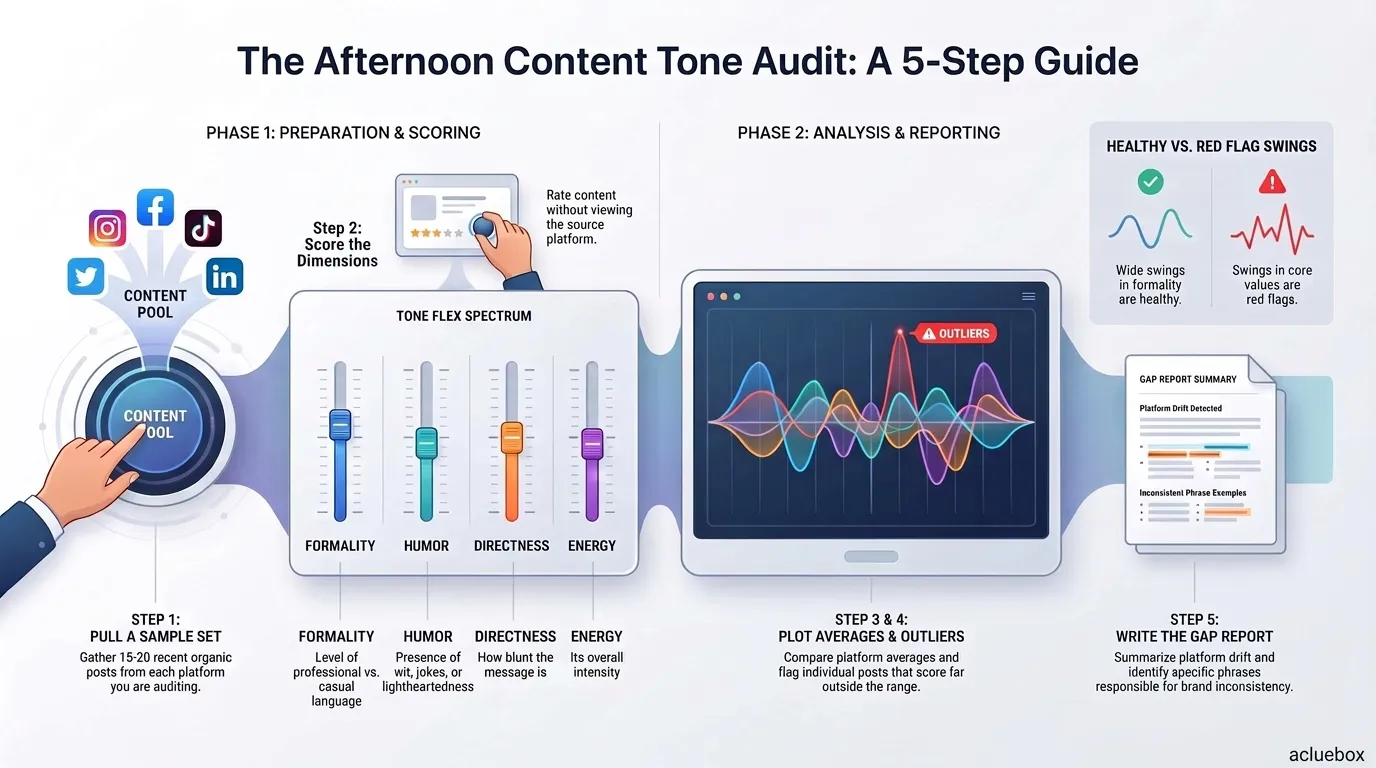
Step 1: Pull a sample set. Gather the last 15 to 20 pieces of content from each platform you are auditing. Use organic posts only at first, since paid copy often follows different internal rules.
Step 2: Score each dimension. Using the tone flex spectrum table above, score each piece of content on formality, humor, directness, and energy. Do this without looking at which platform it came from if possible, to avoid bias.
Step 3: Plot the averages. Calculate the average score per dimension per platform. Wide swings, for example a formality average of 8 on LinkedIn and 1 on TikTok, are expected and healthy. Swings on dimensions that should stay consistent, such as directness or a core value like honesty, are your red flags.
Step 4: Identify the outlier pieces. Beyond averages, flag individual posts that score far outside even the platform's own range. These are usually the pieces that were written under deadline pressure or by someone unfamiliar with the guidelines.
Step 5: Write the gap report. Summarize where the biggest inconsistencies live, which platform is the furthest from brand center, and which specific phrases or content types are most responsible for the drift.
The audit works best when someone outside the channel-owning team does the scoring. Channel owners are often too close to their own content to spot the drift objectively.
If you want to speed up the scoring process, you can hand a batch of posts to an AI model along with your tone flex spectrum and ask it to flag outliers.
You are auditing brand voice consistency across social platforms.

Brand core personality traits: {{core_traits}}
Tone flex spectrum:
- Formality range for {{platform_1}}: {{formality_range_1}}
- Formality range for {{platform_2}}: {{formality_range_2}}
- Humor range for {{platform_1}}: {{humor_range_1}}
- Humor range for {{platform_2}}: {{humor_range_2}}

Here are {{number_of_posts}} sample posts from {{platform_1}} and {{platform_2}}:
{{pasted_content_samples}}

For each post, score formality, humor, directness, and energy from 1 to 10.
Flag any post that falls outside its platform's defined range.
Then summarize the three biggest personality inconsistencies across the full set.
You are auditing brand voice consistency across social platforms.

Brand core personality traits: confident, warm, no-nonsense, occasionally dry humor
Tone flex spectrum:
- Formality range for LinkedIn: 6 to 8
- Formality range for TikTok: 2 to 4
- Humor range for LinkedIn: 1 to 3
- Humor range for TikTok: 5 to 8

Here are 12 sample posts from LinkedIn and TikTok:
[12 pasted post captions go here]

For each post, score formality, humor, directness, and energy from 1 to 10.
Flag any post that falls outside its platform's defined range.
Then summarize the three biggest personality inconsistencies across the full set.
Once the audit surfaces the problem areas, the fix is not to flatten every platform into the same voice. It is to anchor every platform to the same three or four non-negotiable personality traits, then let formality, humor, and energy flex around that anchor.
Start by writing down the traits that should never change, no matter the platform. These usually fall into categories like values (never mock competitors, always credit sources), confidence level (never sound apologetic about pricing or positioning), and relationship to the audience (peer versus authority, playful versus serious).
Next, translate the tone flex spectrum into a one-page reference that every content creator, freelancer, and agency partner receives before they touch your channels. Include two or three example posts per platform that exemplify the correct range, and one example of a post that drifted too far, with a note on why it missed the mark.
Finally, revisit the audit quarterly. Platform norms shift, new team members join, and algorithm changes push creators toward whatever format is currently rewarded. A tone flex spectrum built once and never revisited will drift right back into three companies within two quarters.
Keep the reference document short. A 20-page brand voice bible gets skimmed once and ignored forever. A one-page tone flex spectrum with real examples gets pinned to a Slack channel and actually used.
The goal of this audit is not perfect uniformity. It is recognizability. A follower should be able to read a caption with the brand name blacked out and still guess correctly which company wrote it, on any platform, on any day.
Quarterly is a reasonable default for most brands, though teams posting daily across four or more platforms may benefit from a lighter monthly check on just the highest-risk channels.
Yes, at minimum for every platform where you post organic content regularly. Even platforms that feel similar, like Instagram and TikTok, often warrant slightly different ranges because audience expectations differ.
Bring both to a working session with 10 real examples from competitors or aspirational brands, score those together, and use the disagreement to sharpen the definition rather than letting one person decide unilaterally.
Yes. The scoring exercise takes a few hours and does not require a formal brand department, just a shared spreadsheet and someone willing to read through recent posts objectively.
It should stay within the same core personality traits, but paid copy often sits at the more direct and energetic end of the range since its job is conversion rather than relationship building, so a slightly wider range for paid is normal.

How to Create Your Own Brand Voice (With Prompt & Examples)

The Ultimate Brand Voice Prompt Template for Social Media Copywriting

How to Create Consistent Brand Voice Using AI Prompts on Social Media

AI Prompts for Creating Scroll-Stopping Social Media Captions

Diagnosing Default AI Voice: 10 Signs Your Copy Sounds Like a Bot