
How to Create Consistent Brand Voice Using AI Prompts on Social Media
Discover how to build one recognizable brand voice across every social platform using structured AI prompts, templates, and review workflows.
Discover how to build one recognizable brand voice across every social platform using structured AI prompts, templates, and review workflows.
If you have ever scrolled through your own brand's social feeds and felt like three different companies were posting, you are not alone. One platform sounds like a corporate memo, another sounds like a stand-up routine, and a third sounds like it was written by someone who just discovered exclamation points. This is the sameness problem that most marketing teams run into once AI enters the content pipeline.
The good news is that this is fixable, and it does not require hiring a small army of copywriters. With the right AI prompts, a documented voice profile, and a review habit, you can produce content that sounds unmistakably like your brand, whether it is a LinkedIn thought-leadership post or a punchy TikTok caption. In this guide, we will walk through exactly how to do that, step by step, with prompt templates you can copy right now.
Before AI, brand voice drift happened slowly. A new copywriter joined the team, a freelancer misread the style guide, or a rushed intern posted something off-tone during a product launch. It was noticeable, but it was contained.
AI multiplies this problem. When team members prompt different AI tools without shared guidelines, you get competing personalities instead of a unified voice. Default AI phrasing quickly makes your brand sound generic and interchangeable, eroding audience trust.
It also hurts discovery. Modern search engines and generative AI tools summarize your business based on consistent public signals. If your messaging is fragmented across channels, AI tools will struggle to represent your brand accurately.
Brand voice is the stable personality your brand always has. Tone is how that personality flexes depending on the situation, such as being empathetic in a customer service reply but playful in a meme repost. Confusing the two is one of the most common reasons AI-generated content feels "off."
Consistency does not mean every post sounds identical. It means a reader could cover up your logo and still recognize the post as yours. That recognition comes from a handful of repeatable ingredients:
Ultimately, brand voice reflects how your company interprets customer behavior and frames its role in the market, not just superficial word choice. That means your voice profile must carry genuine perspective and conviction, rather than only cosmetic stylistic rules.
Achieving true brand voice consistency when prompting AI models isn't about finding a single "magic prompt". It requires an architectural system built on four evergreen pillars:
To scale this across content creators and marketing teams, brand voice moves through a 4-phase maturity lifecycle, from initial codification to org-wide governance:
| Phase | Focus Area | Core Milestone | Implementation Goal |
|---|---|---|---|
| Phase 1: Foundations | Codify Before Prompting | Baseline Voice Profile | Diagnose the sameness problem; document vocabulary rules and voice vs. tone boundaries. |
| Phase 2: Multi-Channel | Platform Adaptation | Channel Constraint Layering | Adapt tone natively across LinkedIn, X, and TikTok without diluting or fragmenting core brand perception. |
| Phase 3: Enablement | Team Scaling | Shared Prompt Library | Centralize prompts into version-controlled team templates so freelancers and marketers produce identical quality. |
| Phase 4: Governance | Quality Control & Auditing | Automated Drift Checks | Use AI-assisted review prompts and human sign-offs to catch robotic phrasing and maintain standards at scale. |
Let's break down each pillar in practice, beginning with Phase 1: codifying your voice.
The single biggest mistake teams make is jumping straight into prompting AI tools without first writing down what the brand actually sounds like. AI cannot protect a voice that was never defined.
Phase 1 starts by deconstructing Voice vs. Tone:
If you do not document this separation upfront, your team's prompts will inadvertently tell AI to change its whole personality whenever it changes platforms.
A workable voice profile does not need to be a 40-page document. It needs to be specific enough that two different people, using two different AI tools, would produce recognizably similar output.
Here is a simple structure to fill in:
| Element | What to Define | Example |
|---|---|---|
| Personality traits | 3 to 5 adjectives that describe your brand as a person | Calm, confident, grounded |
| Tone baseline | The default emotional register | Direct and respectful, never hype-driven |
| Vocabulary rules | Words to use, words to avoid | Use "plan," avoid "hack" or "crush it" |
| Sentence style | Structural preference | Short, declarative sentences |
| Reader assumption | Who you're talking to and how smart they are | Intelligent, skeptical, time-constrained |
| Platform flex range | How much tone shifts per channel | More playful on TikTok, more formal on LinkedIn |
This kind of structured "voice block" is exactly what performance-focused marketing teams now embed at the top of every AI prompt so the model has a consistent anchor to work from, rather than reinventing the brand from scratch each time.
Save your voice profile as a reusable snippet in whatever AI tool you use most. Paste it into every prompt instead of retyping it, and update it in one place whenever your positioning shifts. You can also build it quickly using our free Brand Voice Prompt Generator.
Once your voice profile exists, the prompt structure itself becomes simple. A strong brand-voice prompt for social media generally needs five components: role, voice profile, platform rules, content goal, and constraints.
You are a social media copywriter for {{brand_name}}, a {{industry}} brand.

Brand voice profile:
- Personality: {{personality_traits}}
- Tone baseline: {{tone_baseline}}
- Vocabulary to use: {{words_to_use}}
- Vocabulary to avoid: {{words_to_avoid}}
- Sentence style: {{sentence_style}}
- Reader assumption: {{audience_description}}

Platform: {{platform_name}}
Platform-specific rules: {{platform_rules}}

Task: Write {{number_of_variations}} {{content_type}} about {{topic}}.
Goal: {{content_goal}}
Constraints: {{constraints}}
Here is what that looks like filled in for a real brand:
You are a social media copywriter for Northbound Coffee, a specialty coffee subscription brand.

Brand voice profile:
- Personality: Warm, unpretentious, a little wry
- Tone baseline: Friendly and conversational, never preachy about coffee snobbery
- Vocabulary to use: "your morning," "small batch," "roasted this week"
- Vocabulary to avoid: "artisanal," "elevate," "curated"
- Sentence style: Short sentences, occasional single-word sentence for punch
- Reader assumption: Busy professionals who like good coffee but don't want a lecture about it

Platform: Instagram
Platform-specific rules: Caption under 120 words, one light joke allowed, end with a question to invite comments

Task: Write 3 caption variations about our new single-origin Ethiopian roast.
Goal: Drive comments and saves, not just likes
Constraints: No emojis in the first line, no more than 2 emojis total per caption
Notice that nothing in the example is vague. Every variable gives the model something concrete to hold onto, which is exactly why the output stays on-brand instead of drifting toward generic AI copy.
This is where most brands actually fall apart. Not because they lack a voice, but because they treat every platform the same way. One breakdown of social platform voice management points out that a LinkedIn post, a tweet, and a TikTok script are often written by the same brand yet sound like three unrelated companies, leaving the audience confused about who they are actually following.
The fix is not writing a new voice for each platform. It is writing platform-specific rules that sit on top of the same core voice.
| Platform | Voice Stays the Same | What Flexes |
|---|---|---|
| Personality, values, vocabulary | More formal sentence structure, longer form, industry references | |
| Instagram/TikTok | Personality, values | Shorter sentences, more casual rhythm, trend references allowed |
| X (Twitter) | Personality, values | Punchier, wit-forward, real-time reactive |
| Personality, values | Slightly more explanatory, family-friendly framing |
A team building AI workflows at scale in 2026 described this as layering "channel-specific constraints" on top of a single brand voice document, rather than writing separate voice guides per platform. That layered approach is what keeps a brand recognizable everywhere while still feeling native to each feed.
When prompting, add a single line like "Platform context: LinkedIn readers expect more formal structure but the same underlying personality" rather than rewriting your whole voice profile per platform.
Here is a template built specifically for taking one core message and adapting it across channels without losing the thread.
Using the brand voice profile below, adapt the same core message for {{platform_1}}, {{platform_2}}, and {{platform_3}}.

Brand voice profile: {{voice_profile_summary}}

Core message: {{core_message}}

For each platform, follow these adaptation rules:
{{platform_1}}: {{platform_1_rules}}
{{platform_2}}: {{platform_2_rules}}
{{platform_3}}: {{platform_3_rules}}

Keep the personality and vocabulary identical across all three. Only adjust length, formality, and structure.
Using the brand voice profile below, adapt the same core message for LinkedIn, Instagram, and X.

Brand voice profile: Calm, confident, plainspoken. Avoids hype words and exclamation points. Speaks to skeptical, time-constrained readers.

Core message: We just launched a feature that lets teams schedule posts across all platforms from one dashboard.

For each platform, follow these adaptation rules:
LinkedIn: 3-4 sentences, explain the business impact, no emojis
Instagram: Under 80 words, casual, one relevant emoji allowed, end with a call to action
X: Under 240 characters, punchy, no hashtags

Keep the personality and vocabulary identical across all three. Only adjust length, formality, and structure.
Even with a solid prompt, AI models will occasionally slip back into generic, default phrasing, especially over long content batches. This is sometimes called the "robotic-AI problem," where output covers the right topic but fails on personality, quietly reverting to a flat, forgettable tone the moment human oversight relaxes.
Rather than manually rereading every post, you can prompt AI itself to audit a batch of content against your voice profile.
Review the following {{number_of_posts}} social media posts against this brand voice profile:

{{voice_profile_summary}}

For each post, flag:
1. Any word or phrase that violates the "avoid" list
2. Any sentence that feels generic or could belong to any brand
3. A suggested rewrite for flagged sections only

Posts to review:
{{pasted_posts}}
Review the following 5 social media posts against this brand voice profile:

Calm, confident, plainspoken. Avoids "game-changing," "revolutionary," and exclamation points. Sentences are short and declarative.

For each post, flag:
1. Any word or phrase that violates the "avoid" list
2. Any sentence that feels generic or could belong to any brand
3. A suggested rewrite for flagged sections only

Posts to review:
1. "This game-changing update will revolutionize how you post!"
2. "New dashboard is live. Schedule everything in one place."
3. "We're beyond excited to announce our biggest feature yet!!!"
4. "One dashboard. Every platform. No more tab-switching."
5. "This is going to change everything for your team!"
Human review still matters here. AI is good at catching obvious drift, like banned words or overused exclamation points, but a person should make the final call on whether a post genuinely sounds like your brand.
Even teams with a documented voice guide run into the same handful of traps:
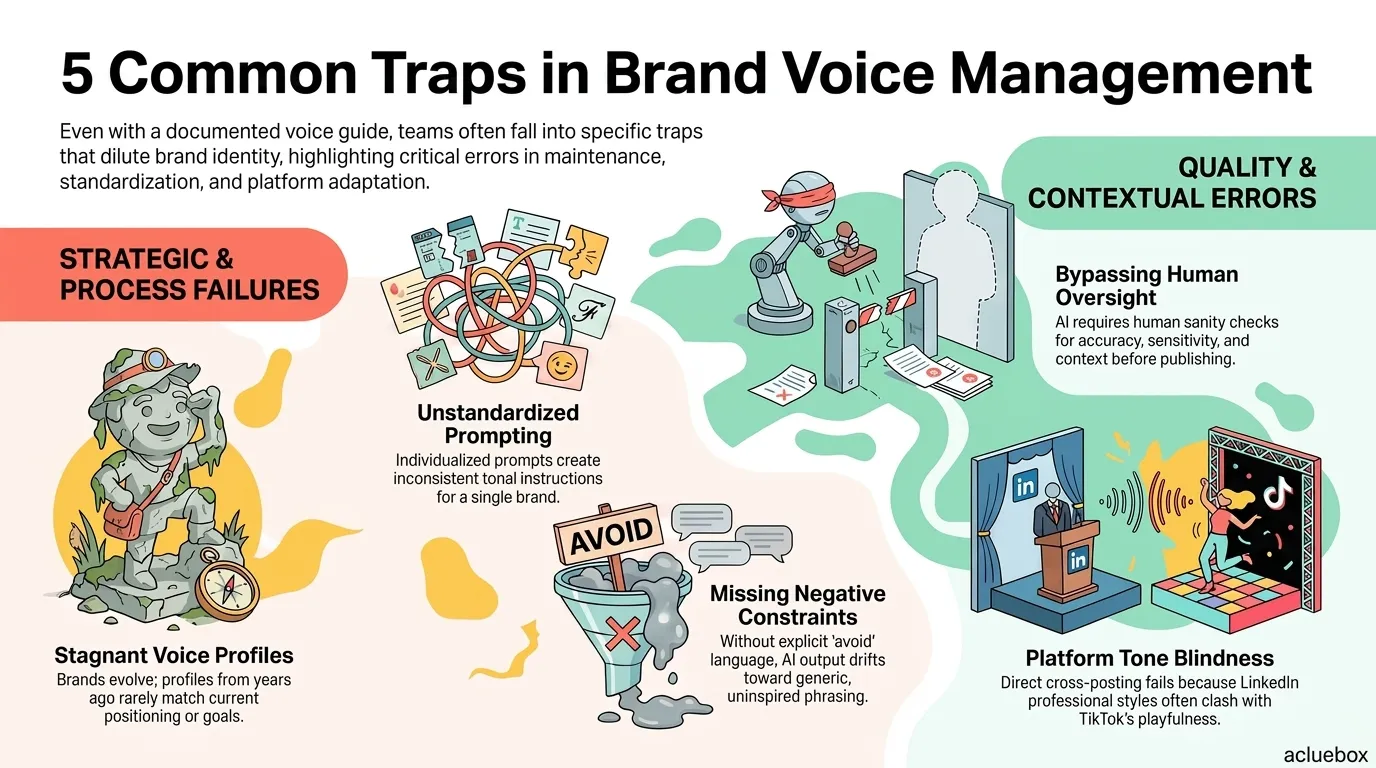
Consistent brand voice on social media is not about finding the perfect one-shot prompt. It is a small system: a documented voice profile, prompt templates that encode that profile, platform-specific adaptation rules, and a lightweight review habit that catches drift before it reaches your audience.
Once that system is in place, AI stops being a risk to your brand's personality and becomes the thing that helps you scale it, post after post, platform after platform, without your audience ever noticing the difference between a Monday caption and a Friday one.
1. What is the difference between brand voice and brand tone?
Brand voice is the consistent personality your brand always has, while tone is how that personality adjusts to different situations, such as being more serious in a crisis response and more playful in a meme repost.
2. Can AI actually keep my brand voice consistent across multiple platforms?
Yes, but only if you feed it a clear voice profile and platform-specific rules in every prompt. Without that structure, AI tools default to generic phrasing that can vary widely between sessions.
3. How often should I update my brand voice profile?
Review it at least once a quarter, and update it any time your positioning, audience, or product offering changes significantly.
4. Do I still need a human to review AI-generated social posts?
Yes. AI is effective at catching obvious drift like banned words or overused phrases, but a person should confirm the final post is accurate, appropriate, and genuinely on-brand before it goes live.
5. What is the easiest way to start if I don't have a brand voice guide yet?
Start small. Write down three to five personality traits, a short list of words to use and avoid, and one sentence describing your typical reader. That alone is enough to noticeably improve AI prompt output.

How to Create Your Own Brand Voice (With Prompt & Examples)

CO-STAR Prompt Framework: Template, Filled Examples, When to Skip It

The Ultimate Brand Voice Prompt Template for Social Media Copywriting

AI Prompts for Creating Scroll-Stopping Social Media Captions

Diagnosing Default AI Voice: 10 Signs Your Copy Sounds Like a Bot