Generate 100+ Ad Variations With AI (Hook × Offer × CTA Matrix)
Don’t ask for 100 ads. Build 8 hooks, 5 bodies, and 4 CTAs, then combine. Copy-paste prompt, a worked SaaS case study (Acluebox), and a filter checklist for slop and claims.
Don’t ask for 100 ads. Build 8 hooks, 5 bodies, and 4 CTAs, then combine. Copy-paste prompt, a worked SaaS case study (Acluebox), and a filter checklist for slop and claims.
Running a handful of ad variations used to be the norm. Write three headlines, swap out one image, call it a test. That approach is fading fast. Top performing advertisers are now feeding 50 or more creative variants into a single campaign, while most teams are still stuck running three to five. The gap between those two groups is not talent or budget. It's tooling.
AI has made it possible to generate dozens, even hundreds, of ad variations from a single brief in the time it takes to make coffee. This guide walks through exactly how that works, what tools to use, how to prompt them properly, and how to avoid the biggest trap of high volume creative: producing 100 ads that all say the same thing in slightly different words.
Modern ad platforms are not designed around a handful of static creatives anymore. Google's Performance Max and Meta's Advantage+ both rely on machine learning to test combinations of headlines, descriptions, and images against real audiences, then shift spend toward whichever combination performs best. The more raw material you feed these systems, the more signal they have to work with.
This is not a small trend. Meta advertisers now run AI-optimized Advantage+ campaigns and Google Ads spend now flows through Performance Max. The algorithmic advantage compounds too: more variants give the system more signal to learn from, which improves delivery, which generates more performance data, and so on.
Volume alone does not guarantee performance. A platform's algorithm can only optimize toward variations that are genuinely different from one another. Ten near-identical headlines give it almost nothing to learn from.
The financial case is just as strong. Marketing teams have historically spent an average of 12 hours per week manually pulling reports and building creative from scratch. Creative automation compresses that cycle from days into minutes, freeing budget that used to go toward design and copywriting hours into media spend instead.
At a technical level, AI ad generation tools combine a few core capabilities, and understanding the mechanics and tools of AI ad generation helps you get better output.
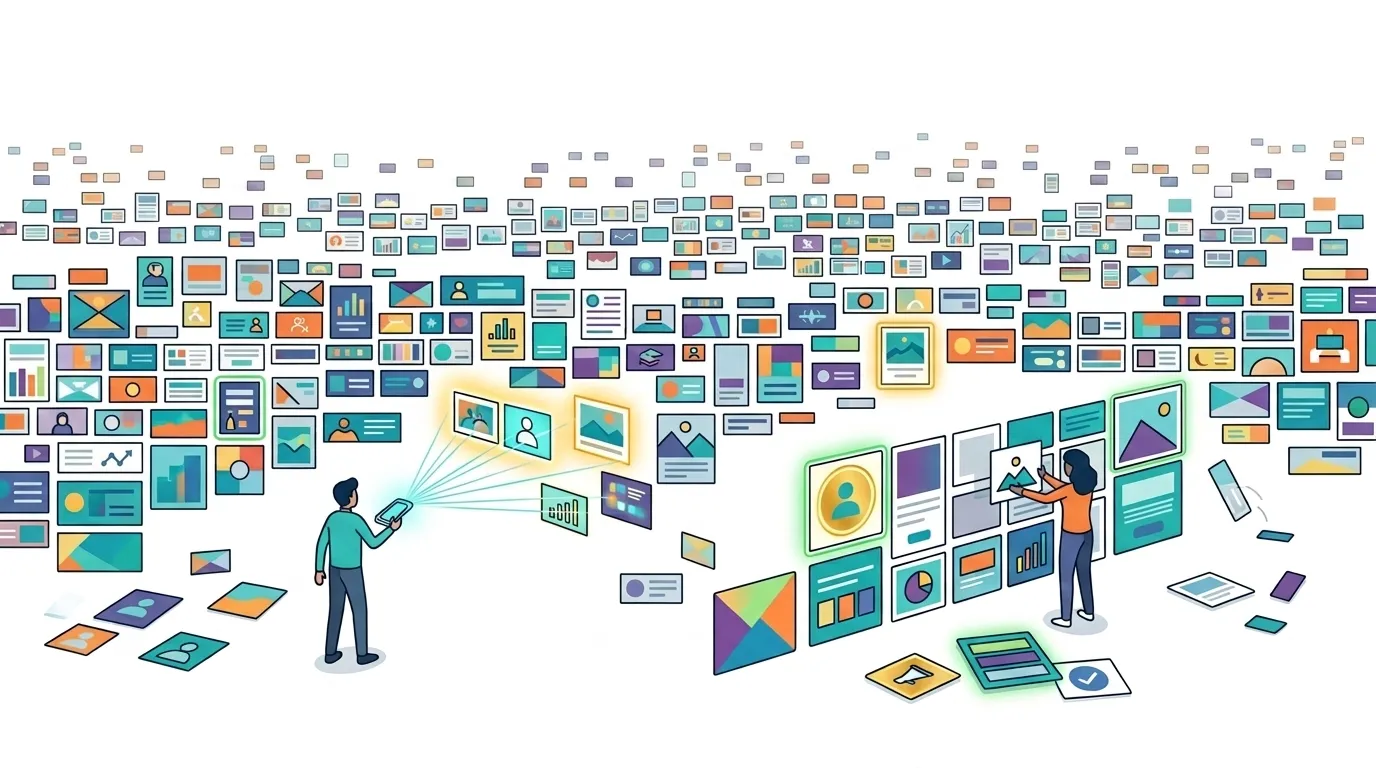
Put simply: you are not asking AI to write 100 completely separate ads. You are asking it to generate a set of strong building blocks (angles, hooks, CTAs, visual directions) and then letting a system recombine those blocks into a large volume of testable units.
Think in layers, not in single ads. Generate 8 to 10 distinct hooks, 5 to 8 CTA styles, and 3 to 5 visual directions. Multiplied together, that's well over 100 unique combinations from a fraction of the manual effort.
| Layer | Modular Count | Primary Role | Output Math |
|---|---|---|---|
| Layer 1: Hooks & Headlines | 8 distinct hooks | Stops the scroll and triggers immediate emotional curiosity | 8 angles |
| Layer 2: Bodies & Offers | 5 core bodies | Bridges the problem to the solution and establishes value | × 5 narratives |
| Layer 3: Calls to Action | 4 actionable CTAs | Directs low-friction next steps and closes conversions | × 4 triggers |
| Total Testable Ads | 17 modular assets | Recombined dynamically across ad sets | 160 Unique Ad Variations |
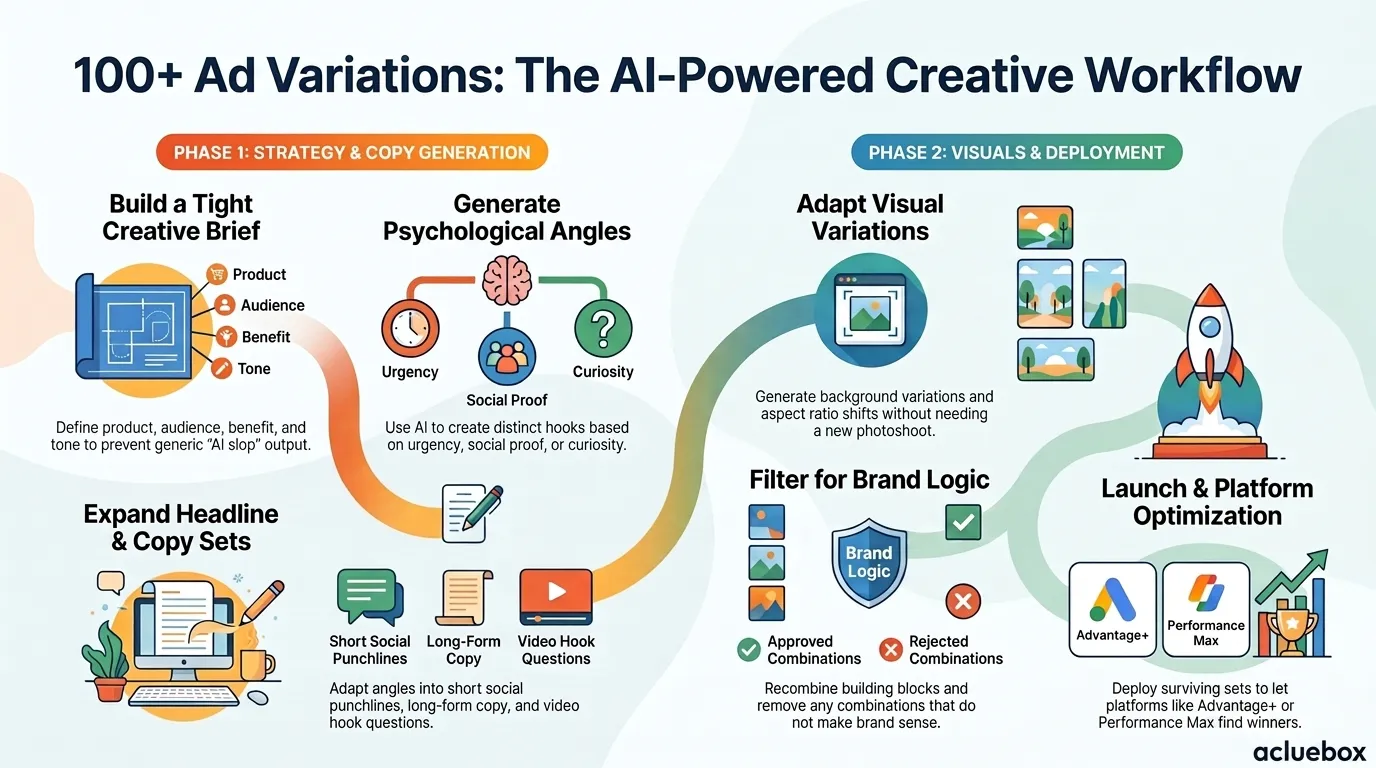
The single biggest driver of good AI output is a specific brief. Vague prompts produce generic, interchangeable ads, which is exactly the "AI slop" problem audiences are starting to notice. Before touching a tool, define your product, audience, key benefit, tone, and constraints.
Start with the text layer. Ask the model to produce distinct psychological angles, not just reworded sentences. Angles might include urgency, social proof, curiosity, fear of missing out, or a direct feature callout.
Once you have angles, expand each one into multiple headline lengths and copy formats (short punchy lines for social, longer benefit-driven copy for search, question-based hooks for video).
Feed your product images or brand assets into a generative image tool to create background variations, aspect ratio adaptations, and style variants without a new photoshoot.
Recombine your text and visual building blocks, then filter out combinations that don't make logical or brand sense before pushing to your ad platform. Run every batch through a pre-launch compliance checklist to intercept unverified claims and brand hallucinations before spending budget.
Push the surviving set into your campaign and let the platform's own optimization layer (Advantage+, Performance Max, or your own testing dashboard) start allocating spend toward winners.
Act as a senior direct-response copywriter.

Product: {{product_name}}
Audience: {{target_audience}}
Core benefit: {{main_benefit}}
Tone: {{brand_tone}}
Platform: {{ad_platform}}
Constraints: {{character_limit_or_rules}}

Generate {{number_of_variations}} distinct ad angles for this product.
For each angle, provide:
1. A one-line description of the psychological hook
2. Three headline variations (under {{headline_character_limit}} characters)
3. One short body copy variation (under {{body_character_limit}} characters)
4. One call to action

Make sure each angle is meaningfully different in approach, not just reworded.
Avoid generic marketing language and avoid making unverifiable claims.
View this guide to produce a first batch of headline and copy variations.
Act as a senior direct-response copywriter.

Product: Acluebox (AI Prompt Builder & Workspace SaaS)
Audience: Growth marketers, copywriters, and paid media advertisers
Core benefit: Build, test, and organize reusable prompt systems that generate high-converting ad variations in seconds
Tone: Sharp, authoritative, practical, zero corporate jargon
Platform: Meta Feed, LinkedIn, and X (Twitter)
Constraints: headlines under 40 characters, body copy under 125 characters

Generate 10 distinct ad angles for this product.
For each angle, provide:
1. A one-line description of the psychological hook
2. Three headline variations (under 40 characters)
3. One short body copy variation (under 125 characters)
4. One call to action

Make sure each angle is meaningfully different in approach, not just reworded.
Avoid generic marketing language and avoid making unverifiable claims.
Run the same prompt with the tone variable changed (playful, authoritative, urgent, minimalist) to multiply your output further without starting from scratch.
Applying the combinatorial framework to Acluebox, we break down the creative assets into 8 distinct hooks, 5 bodies, and 4 CTAs. Instead of prompting an AI for 100 disjointed, generic ads, these 17 modular assets combine to yield 160 distinct ad variations (8 × 5 × 4 = 160) ready for automated creative testing across Meta Advantage+, LinkedIn, and Google PMax.
| # | Hook Angle | Headline (< 40 chars) | Psychological Trigger |
|---|---|---|---|
| 1 | Staring at Blank Screen | "Stop staring at empty prompt boxes." | Friction fatigue and creative block |
| 2 | Robotic "AI Slop" Fear | "Tired of AI ads that sound robotic?" | Frustration with bland, generic AI output |
| 3 | Rapid Campaign Velocity | "Build 100 ad variations before lunch." | Extreme time-saving and productivity advantage |
| 4 | Chaos vs System | "Prompts shouldn't live in messy docs." | Organizational pain and lost team knowledge |
| 5 | Performance & ROAS Focus | "Better prompt inputs = 2x ad clicks." | Direct ROI and conversion upside |
| 6 | No Prompt Engineer Needed | "You don't need a prompt engineer." | Demystification and empowerment |
| 7 | Insider Playbook | "The prompt system top agencies hide." | Curiosity and competitive advantage |
| 8 | Zero-Cost Entry | "Generate your first 20 hooks for $0." | Low-risk friction removal |
| # | Angle Focus | Body Copy (< 125 chars) | Core Value Proposition |
|---|---|---|---|
| 1 | Proven Frameworks | "Turn vague briefs into winning angles. Built-in RTF and CO-STAR frameworks ensure your ad copy hits every time." | Eliminates prompt guesswork |
| 2 | Team Workspace | "Stop losing winning prompts in Slack or Apple Notes. Organize, version-control, and share your team's prompt stack." | Centralized prompt organization |
| 3 | Combinatorial Engine | "Plug in your product and audience. Automatically generate 8 hooks, 5 bodies, and 4 CTAs formatted for paid ads." | Scaled creative variation |
| 4 | Anti-Slop Guardrails | "Filter out banned marketing buzzwords, vague claims, and platform truncation before you spend a single ad dollar." | Brand safety and quality control |
| 5 | Free Generator Access | "Test our free ad variation tool with zero setup. Instant CSV export ready for Meta Advantage+ and Google PMax." | Low-friction product-led growth |
| # | Action Style | CTA Copy | Primary Conversion Goal |
|---|---|---|---|
| 1 | Low-Friction Trial | "Try The Free Ad Generator" | Top-of-funnel tool usage with zero friction |
| 2 | Direct Workspace Setup | "Build Your Prompt System" | High-intent account creation |
| 3 | Template Discovery | "Explore 50+ Ad Templates" | Engages marketers seeking immediate swipe files |
| 4 | High-Velocity Value | "Generate 100 Variations Free" | Direct incentive for immediate adoption |
By dynamically pairing any Hook with any Body and any CTA, you generate testable, cohesive ad variations tailored for performance campaigns:
| Variant | Component Formula | Complete Headline | Complete Body Copy | Call to Action |
|---|---|---|---|---|
| Ad #01 | Hook 1 + Body 2 + CTA 2 | "Stop staring at empty prompt boxes." | "Stop losing winning prompts in Slack or Apple Notes. Organize, version-control, and share your team's prompt stack." | Build Your Prompt System |
| Ad #18 | Hook 2 + Body 4 + CTA 1 | "Tired of AI ads that sound robotic?" | "Filter out banned marketing buzzwords, vague claims, and platform truncation before you spend a single ad dollar." | Try The Free Ad Generator |
| Ad #43 | Hook 3 + Body 3 + CTA 4 | "Build 100 ad variations before lunch." | "Plug in your product and audience. Automatically generate 8 hooks, 5 bodies, and 4 CTAs formatted for paid ads." | Generate 100 Variations Free |
| Ad #77 | Hook 4 + Body 1 + CTA 3 | "Prompts shouldn't live in messy docs." | "Turn vague briefs into winning angles. Built-in RTF and CO-STAR frameworks ensure your ad copy hits every time." | Explore 50+ Ad Templates |
| Ad #128 | Hook 8 + Body 5 + CTA 1 | "Generate your first 20 hooks for $0." | "Test our free ad variation tool with zero setup. Instant CSV export ready for Meta Advantage+ and Google PMax." | Try The Free Ad Generator |
| Approach | Best For | Speed | Human Oversight Needed |
|---|---|---|---|
| Native platform tools (Meta Advantage+, Google PMax) | Advertisers already spending inside Meta or Google | Fast, built into campaign setup | Medium, review before launch |
| Standalone AI ad generators (e.g. AdCreative.ai) | Teams needing copy and visuals outside platform tools | Very fast, minutes per batch | High, brand voice editing required |
| Custom LLM prompting workflow | Teams with strict brand guidelines or niche products | Moderate, depends on prompt iteration | High, manual curation |
| Full-service AI agencies or platforms (e.g. Multiply) | B2B teams wanting sales data folded into ad copy | Slower setup, ongoing automation after | Low once configured |
Native platform tools like Meta's Advantage+ Creative now include text variation, image expansion, and background generation directly inside campaign setup, which is often the fastest starting point if you already advertise there, according to TechCrunch's coverage of Meta's generative ad tools.
High-volume creative only succeeds if each variation brings a genuinely distinct angle while maintaining an authentic voice. When teams flood ad feeds with generic, machine-spun copy, audience fatigue sets in fast. People quickly tune out campaigns that feel repetitive or soulless, and engagement drops sharply when ad creative lacks relatable, real-world substance.
The risk isn't just aesthetic, it directly hits campaign performance. Audiences instinctively push back when automated messaging feels disconnected from a brand's established identity or emotional tone. The breakdown rarely stems from technical polish; it happens when high-speed generation strips away the personal connection, nuance, and trust that drove conversions in the first place.
Use AI to generate the volume, but keep a human in the loop for final selection, brand voice checks, and any claim verification. AI is infrastructure for creative volume, not a replacement for judgment.
Before launching 100+ generated variants into an ad account, run this five-point filter pass to prune generic AI hallucinations, policy risks, and repetitive copy:
| Quality Gate | AI Red Flag ("Slop" Warning) | Human-in-the-Loop Fix | Acluebox Filtered Example |
|---|---|---|---|
| Claim Verification | "Guaranteed #1 prompt tool that triples your ROAS" (unverified superlative) | Replace with verifiable software features or practical workflows | "Pre-built RTF and CO-STAR frameworks with instant CSV export" |
| Slop & Cliché Removal | "Revolutionize your team's synergy with this game-changer" | Strip marketing fluff; state concrete, measurable time savings | "Build 100 structured ad variations in under 5 minutes" |
| Character Truncation | Headline exceeds mobile single-line cutoff (> 40 characters) | Hard-trim to platform safe limits (< 38 characters) | "Stop staring at empty prompt boxes." (35 chars) |
| Offer Alignment | CTA implies "Free Unlimited Lifetime Access" when tier is freemium | Align CTA incentives with actual landing page signup terms | "Try The Free Ad Generator" |
| Angle Distinctness | Multiple hooks merely repeating synonyms ("Fast / Quick / Rapid") | Ensure each angle triggers a distinct psychological emotion | Rotate between Creative Block, Team Chaos, Slop Fear, and Scaled Velocity |
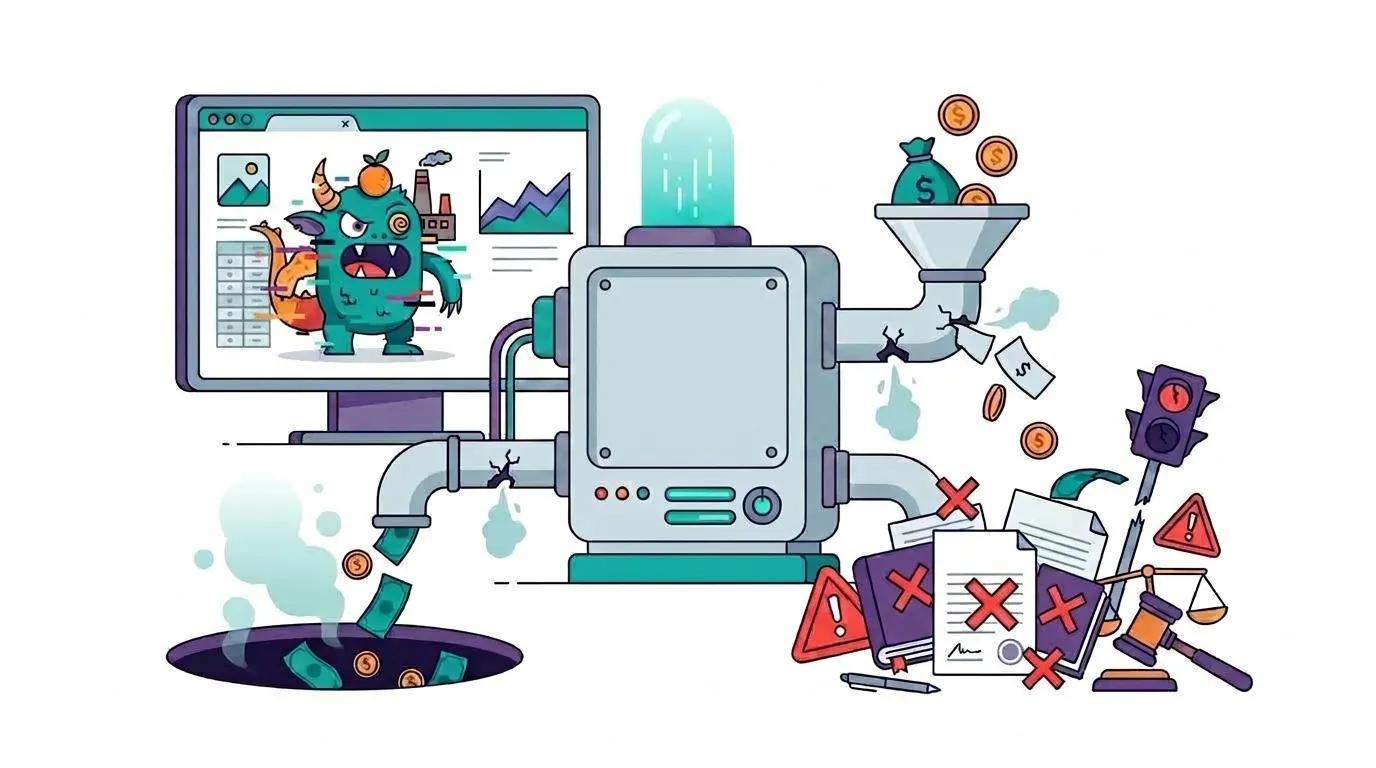
Generating 100+ variations in minutes unlocks massive creative volume, but it also multiplies risk if an unchecked model hallucinates performance metrics, discounts, or regulatory claims. Before bulk-uploading variants to Meta Advantage+ or Google PMax, run this quick 6-point compliance check:
This quick checklist keeps everyday ad production safe, but scaling automated creative requires managing deeper systemic risks across visuals, legal exposure, and ad spend. For a comprehensive investigation into why diffusion models mangle logos, how LLMs trigger regulatory scrutiny, and why excessive variants dilute testing budgets and ruin statistical significance, read our companion spoke guide: The Hidden Pitfalls of AI Ads: Brand Hallucinations, Compliance Risks, and Budget Dilution.
There is no single best tool for every advertiser. The right pick depends on where you already spend and how much creative control you need.
If you are running most of your budget through Meta or Google, start with their native generative features before adding a third-party layer. These are already built into the bidding and delivery system, so variations you generate are automatically tested against your existing audiences.
If you need copy and visuals independent of any single platform, or you're producing ads that will run across search, social, and display simultaneously, a standalone generator gives you more portability. Just budget extra time for editing, since off-the-shelf output tends to need brand voice adjustments.
For B2B teams with longer sales cycles, tools that fold real customer language into ad generation are worth a look. One recent example uses actual sales call transcripts and CRM data to generate ad copy, with the company behind it reporting that what used to start as ten ads can expand into hundreds of experiments that evolve based on what actually converts into pipeline.
Generating volume is the easy part. Measuring ad success is where most teams stumble. A few practical guardrails:
Generating 100+ ad variations in minutes is no longer a novelty reserved for large agencies with big budgets. Between native platform tools, standalone AI generators, and simple prompt templates run through any capable language model, a solo marketer or small team can now produce the same creative volume that used to require a full production department.
The advertisers who benefit most are not the ones chasing the highest possible ad count. They're the ones treating AI as a way to multiply genuinely distinct ideas, keeping a human hand on final selection and brand voice, and letting the platform's own optimization engine do what it does best: find the combination that actually converts.
Start small. Take one product, build a tight brief, run it through the prompt template above, and generate your first batch of 20 or 30 variations before scaling to 100. You'll get a feel for what "distinct" actually looks like before you're managing a much larger set.
1. How does AI generate over 100 ad variations so quickly?
AI tools generate a set of core building blocks (headlines, hooks, CTAs, and visual directions) and then recombine them into distinct ad units. A handful of angles multiplied against several formats and visuals quickly produces well over 100 unique combinations.
2. Do I need design or copywriting experience to use AI for ad generation?
No, but some editing skill helps. Most tools produce a strong starting point that still benefits from a human pass for brand voice, tone, and claim accuracy before launch.
3. Will AI-generated ads hurt my brand if audiences realize they're AI-made?
It can, particularly if outputs rely on lazy clichés, make unverifiable claims, or use distorted product imagery. Running a pre-launch compliance check and consulting our spoke guide on AI ad hallucinations and compliance risks protects your brand equity while keeping creative velocity high.
4. Which platforms are best for testing 100+ ad variations at once?
Meta's Advantage+ and Google's Performance Max are both built to test large creative sets automatically, since they use machine learning to shift spend toward top performers within the campaign itself.
5. Is there a risk of generating too many similar ads instead of truly different ones?
Yes, and it's the most common mistake. Focus on generating distinct psychological angles first, then vary format and visuals within each angle, rather than asking for "100 headlines" in one flat request.