
Diagnosing Default AI Voice: 10 Signs Your Copy Sounds Like a Bot
The banned vocabulary list and 10 telltale signs that expose unedited AI copy, from hollow hype to the word delve.
The banned vocabulary list and 10 telltale signs that expose unedited AI copy, from hollow hype to the word delve.
Your reader gets three sentences into your latest blog post and quietly closes the tab. They can't quite explain why but what they're reacting to has a name now: Default AI Voice, and it's become one of the fastest ways to lose a reader's trust in 2026.
Default AI Voice is the flattened, generically upbeat, over-qualified tone that large language models fall into when nobody edits their output. It isn't bad writing in the traditional sense. It's writing that has been sanded down until every rough, specific, human edge is gone. And once you learn to spot it, you cannot unsee it.
Default AI Voice describes the tone a language model produces when it's given a generic instruction and no strong stylistic guardrails. It tends to be:
None of these traits are disqualifying on their own. The problem is density. One instance of "delve" in a 2,000-word article is a stylistic choice. Five instances, paired with three rhetorical questions and a closing paragraph that starts with "In conclusion", is a pattern. Patterns are what readers subconsciously register, and once they register it, the copy stops feeling like it came from a person who understands their problem and starts feeling like a templated response.
Default AI Voice isn't caused by AI itself. It's caused by unedited AI output. The fix isn't avoiding AI tools, it's building an editing pass specifically designed to catch these patterns.
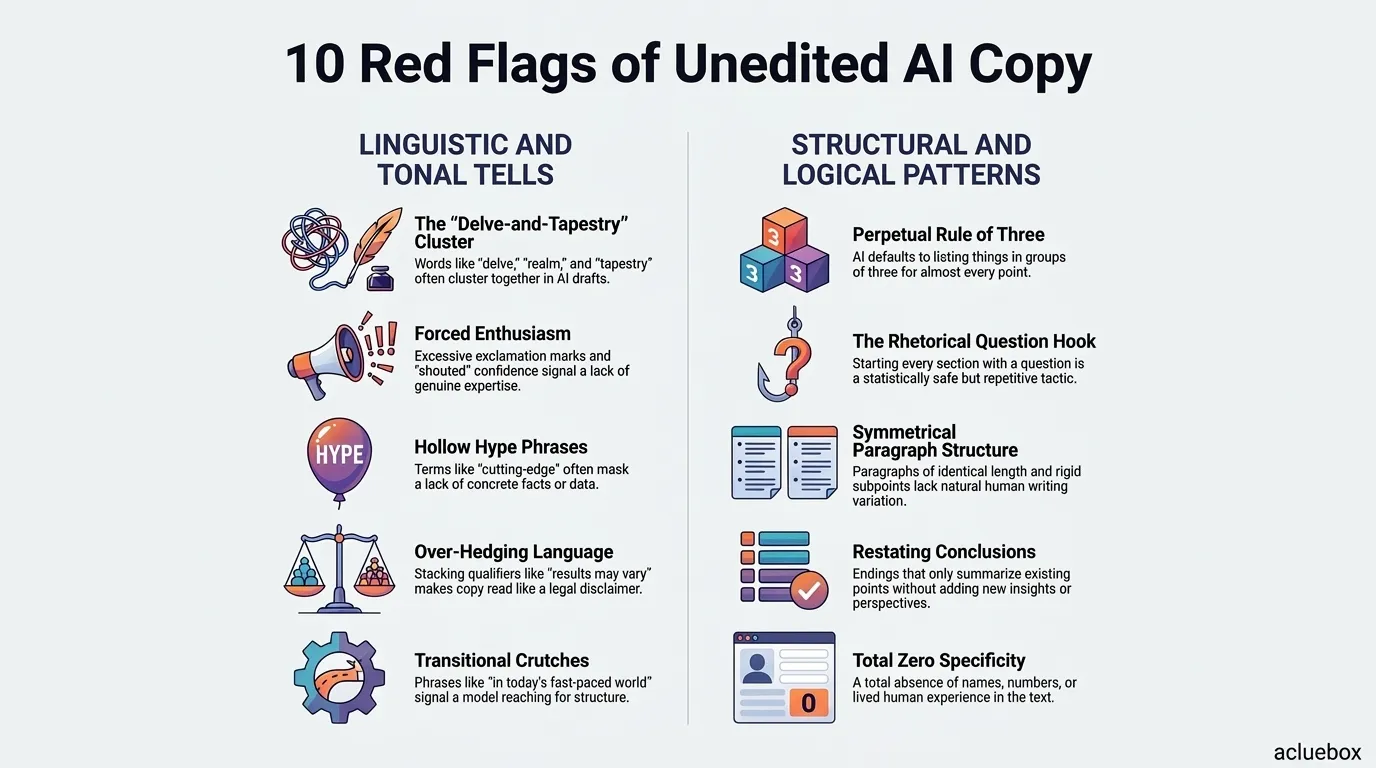
Certain words cluster together in AI-generated text far more than in human writing: delve, tapestry, realm, landscape, testament, myriad, boasts. Individually harmless, but when three or four show up in the same piece, it reads like it was assembled from the same template as a thousand other articles.
Default AI Voice treats every sentence as an opportunity to sound thrilled. "This feature will transform your workflow!" "You'll love how easy this is!" Real experts rarely need exclamation points to prove something is good. Confidence sounds calm, not shouted.
AI models love listing things in threes: "fast, efficient, and reliable". "Clear, concise, and compelling". Used once, it's a rhetorical device. Used in every paragraph, it becomes a tic that readers start finishing in their head before you do.
Phrases like "cutting-edge solution", "unlock your potential", or "revolutionize the way you work" sound impressive but say nothing. Hollow hype is a symptom of a model generating confident-sounding language without a concrete fact, number, or example to anchor it.
"It's important to note that results may vary depending on several factors". Hedging isn't dishonest, but stacking qualifiers on every claim makes copy read like a legal disclaimer instead of a point of view. Humans commit to statements. Default AI Voice tiptoes around them.
"Have you ever wondered why your emails go unanswered?" This opener shows up constantly in AI drafts because it's a statistically safe way to start a paragraph. Used sparingly, it works. Used as the default hook for every section, it starts to feel like a customer service script.
Every paragraph is the same length. Every section has exactly three subpoints. Every list has the same number of items as the one before it. Human writing breathes unevenly: a short punchy line followed by a longer explanatory one. Default AI Voice irons that variation flat.
Certain sentence frames function as connective tissue for AI models when they aren't sure how to transition. "Not only does this save time, but it also improves accuracy". "In today's fast-paced digital landscape". These phrases signal that the model reached for structure instead of substance.
"In conclusion, by following these tips, you can improve your results". A good ending adds a final insight, a next step, or a shift in perspective. Default AI Voice conclusions just summarize what was already said, in slightly different words, as if closing a five-paragraph school essay.
This is the deepest tell. Unedited AI copy describes concepts in the abstract because it has no lived experience, no proprietary data, and no actual customer story to draw from. If an article about email marketing never mentions a real open rate, a specific tool, or a named scenario, it was probably never touched by someone who does the work.
Read your draft out loud. If you catch yourself skimming your own sentence because it sounds like it could belong to any brand, that's Default AI Voice. Specificity is the fastest way out.
Here's a working list to screen your drafts against. This isn't exhaustive, and none of these words are forbidden in isolation, but if your document has more than two or three of these in a single piece, it's worth a rewrite pass.
| Category | Banned Words and Phrases | Why It's a Red Flag |
|---|---|---|
| Verbs | delve, unlock, harness, leverage, elevate, navigate | Overused as generic action verbs regardless of actual topic |
| Nouns | tapestry, realm, landscape, journey, testament, myriad | Vague, abstract nouns that replace concrete detail |
| Adjectives | game-changing, cutting-edge, robust, seamless, innovative | Hype adjectives with no supporting evidence |
| Transition Phrases | "In today's world", "It's important to note", "Not only... but also" | Filler transitions that avoid a real connective idea |
| Closers | "In conclusion", "At the end of the day", "The bottom line is" | Signals a summary instead of a genuine final thought |
| Punctuation Habits | Multiple exclamation marks per section, rhetorical questions as every opener | Forced enthusiasm instead of earned emphasis |
This list will keep evolving. As detection tools and readers get better at spotting AI phrasing, models shift their defaults too. Revisit this list every few months rather than treating it as permanent.
Before publishing anything drafted with AI assistance, run it through this quick pass:
This checklist takes about five minutes and catches the majority of Default AI Voice issues before a reader ever sees them.
Rather than relying only on a manual pass, you can build the diagnosis directly into your editing workflow with a targeted prompt. This works well as a second-pass step after your first draft is generated or written.
Act as a strict editor specializing in detecting generic AI writing patterns.

Review the following draft and identify:
1. Any words or phrases from this banned list: {{banned_word_list}}
2. Sentences with excessive hedging or over-qualification
3. Paragraphs that follow a repetitive "rule of three" structure
4. Any section opener that uses a rhetorical question
5. Places where the copy makes a claim without a specific number, name, or example
6. Whether the conclusion restates the intro instead of adding new value

For each issue found, quote the exact sentence and suggest a specific, more concrete rewrite in a voice that matches: {{brand_voice_description}}

Draft to review:
{{draft_content}}
Act as a strict editor specializing in detecting generic AI writing patterns.

Review the following draft and identify:
1. Any words or phrases from this banned list: delve, tapestry, unlock, cutting-edge, seamless, in today's world, in conclusion
2. Sentences with excessive hedging or over-qualification
3. Paragraphs that follow a repetitive "rule of three" structure
4. Any section opener that uses a rhetorical question
5. Places where the copy makes a claim without a specific number, name, or example
6. Whether the conclusion restates the intro instead of adding new value

For each issue found, quote the exact sentence and suggest a specific, more concrete rewrite in a voice that matches: direct, confident, slightly informal, no corporate jargon, writes like a knowledgeable colleague explaining something over coffee

Draft to review:
"In today's fast-paced digital landscape, businesses are constantly looking to unlock new levels of efficiency. Our platform boasts a seamless, robust, and innovative approach to project management. Have you ever wondered why your team struggles to stay on track? By leveraging our tools, you can delve into a new realm of productivity. In conclusion, our solution is the game-changing answer you've been searching for!"
Running a draft through this kind of prompt surfaces the exact sentences worth rewriting instead of leaving you to guess where the copy went generic.
Diagnosis is only half the job. Once you've flagged the patterns, here's how to actually fix them.
Our tool dramatically improves efficiency.
Our tool cut onboarding time from four days to six hours for our last three enterprise clients.
The second version is longer, but it's the one people actually believe.
Trade the rule of three for asymmetry. If every list has exactly three items, break the pattern deliberately. Two sharp points often land harder than three padded ones.
Kill one exclamation mark per paragraph until only the ones that truly earn it remain. Confidence reads calmer than you'd expect.
Have you ever wondered why your emails go unanswered?
Most cold emails get ignored because they open with a question the reader already knows the answer to.
The second version demonstrates expertise instead of performing curiosity.
Give your conclusion one new idea. Instead of restating the introduction, end with a forward-looking recommendation, a caveat worth knowing, or a next step the reader can take today.
A useful test: would a competitor's brand be comfortable publishing this exact paragraph with their logo instead of yours? If yes, it's too generic. Rewrite until the answer is no.
The teams that consistently avoid Default AI Voice don't rely on memory or vigilance alone. They bake the checklist into their process. That usually looks like:
None of this requires abandoning AI-assisted drafting. It just means treating the first draft as raw material, not a finished product. The words are cheap to generate now. What's actually valuable is the editorial judgment that turns generic output into something a reader trusts enough to keep reading.
Is it bad to use AI-generated words like "delve" at all?
No single word ruins a piece of writing. The issue is frequency and clustering. One instance of "delve" in a long article is unremarkable. The problem starts when several banned-list words appear together, because that's when the pattern becomes noticeable to readers and detection tools alike.
Can AI detection tools reliably catch Default AI Voice?
Detection tools can flag statistical patterns, like unusually consistent sentence length or overrepresented vocabulary, but they aren't perfect and can produce false positives on genuinely human writing that happens to be very structured. Treat detectors as one signal among several, not a final verdict.
Does editing out these signs guarantee my content won't sound like AI?
Removing the ten signs listed here significantly reduces the generic feel, but true brand voice comes from adding things AI can't generate on its own: specific customer stories, proprietary data, and a genuine point of view. The checklist gets you out of the danger zone; original substance is what makes the writing distinctly yours.
How often should I update my banned vocabulary list?
Every few months is a reasonable cadence. As AI models update and as more brands publish AI-assisted content, certain words and phrases go in and out of overuse. What sounds generic today may shift, so treat the list as a living document rather than a fixed rule.
Should I ban AI tools entirely to avoid this problem?
Not necessarily. AI tools are useful for drafting speed and structure. The issue isn't the tool, it's shipping the first output without an editorial pass focused on voice. Teams that build a dedicated diagnosis step into their workflow can use AI extensively while still publishing content that sounds distinctly their own.
How to Create Your Own Brand Voice (With Prompt & Examples)

How to Create Consistent Brand Voice Using AI Prompts on Social Media

The Ultimate Brand Voice Prompt Template for Social Media Copywriting
The Platform Personality Gap Audit: Fixing Brand Voice Inconsistency
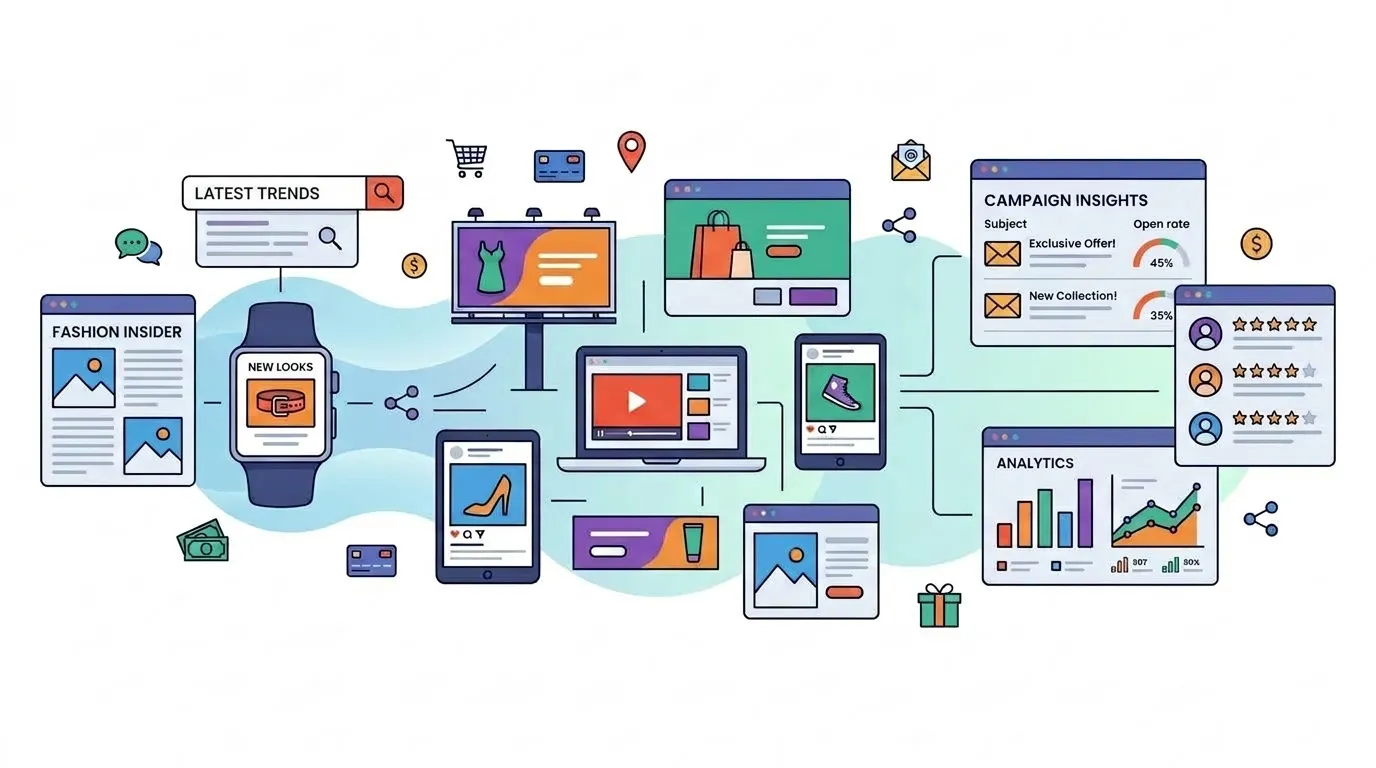
AI for Advertising Workflows: How to Streamline from Brief to Creative