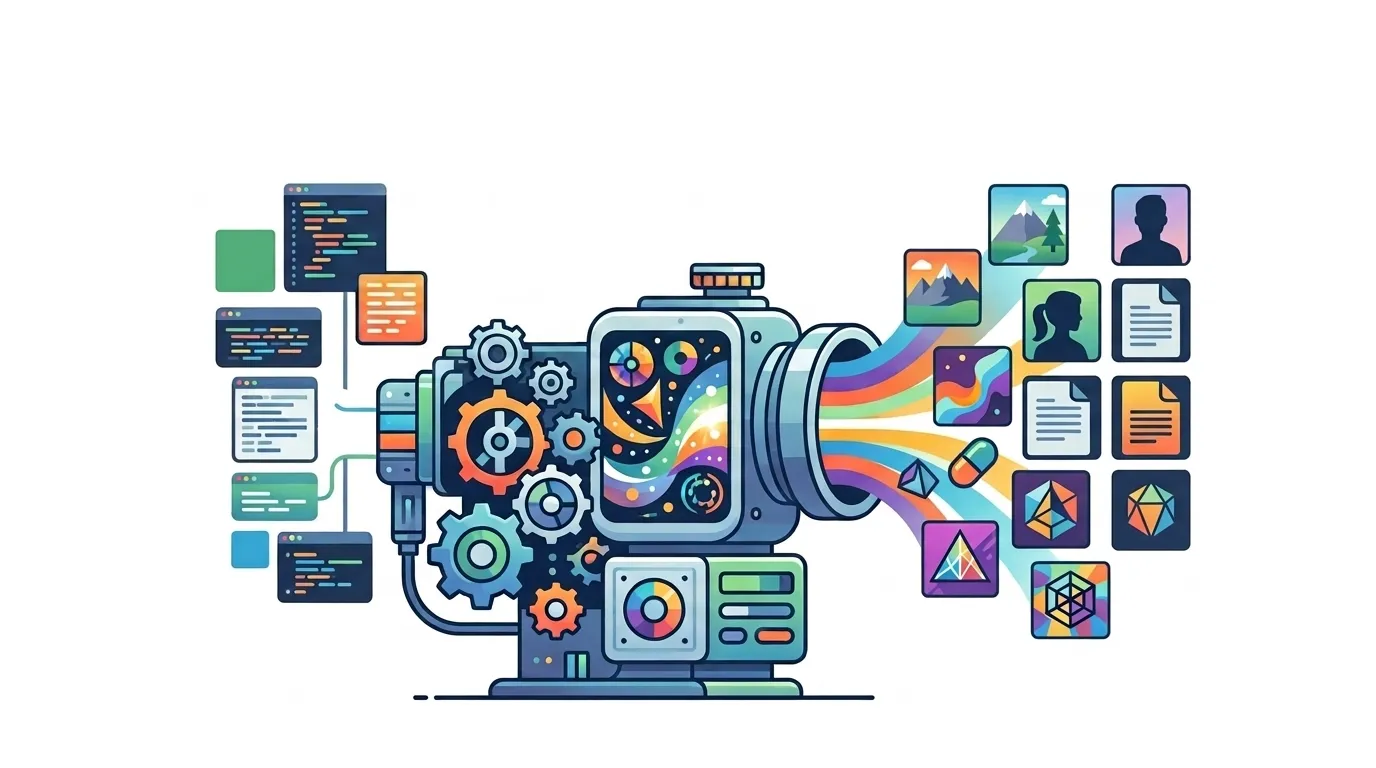
The Mechanics and Tools of AI Ad Generation
Inside the tech stack behind AI-made ads, from LLM copywriting to generative visuals, plus how Advantage+ and Performance Max compare to standalone tools.
Inside the tech stack behind AI-made ads, from LLM copywriting to generative visuals, plus how Advantage+ and Performance Max compare to standalone tools.
Open any ad account today and you'll notice something strange: nobody is really "designing" ads anymore. They're feeding inputs into a system and watching dozens of variations appear in seconds. That shift didn't happen by accident. Underneath every AI-generated ad is a small assembly line of models, each handling a different piece of the job, working together so fast that the whole process feels like magic.
It isn't magic. It's mechanics. And once you understand how the pieces fit together, you can pick better tools, spot their limitations, and stop treating AI ad generators as black boxes.
The phrase gets used loosely, so it's worth being precise. Modern AI ad generation is rarely a single model doing everything. It's a pipeline made of three distinct technologies, each solving a narrower problem:
None of these three does the whole job well on its own. An LLM without a combinatorial layer just gives you a list of headlines you still have to place manually. A generative design tool without brand guardrails will happily produce an image that looks nothing like your product. The value of an AI ad platform is mostly in how well it stitches these layers together, not in how flashy any single layer looks in a demo.
When evaluating a tool, ask what it actually generates versus what it assembles. Some platforms market themselves as "AI ad generators" but are really combinatorial engines wrapped around someone else's LLM and image API.

LLMs are the part of the stack most people already understand, since they're the same family of models behind general-purpose chatbots. In an ad context, the model is typically given a structured prompt built from:
From that input, the model produces multiple copy variants rather than a single "best" answer. This matters because ad platforms increasingly reward variety. Meta and Google's delivery systems perform their own testing across creative variants, so a generator that only hands you one polished headline is actually working against how modern ad auctions function.
Most serious tools also apply a second pass after generation: a filtering or scoring step that checks length limits, flags claims that might violate platform policy (superlatives, medical claims, guaranteed results), and removes near-duplicate variants. This is where the quality gap between tools shows up. A raw LLM call is easy to build. A reliable filtering and compliance layer on top of it is not, and it's usually the difference between a tool that saves you time and one that creates work reviewing its output.
If you're testing a new AI copy tool, ask it to generate ten headline variants for the same product and check how many are meaningfully different in angle (price, urgency, social proof, feature-led) rather than just reworded synonyms of the same idea. Angle diversity is a better signal of quality than fluency.

Visual generation in advertising splits into two very different approaches, and mixing them up leads to disappointment.
Full image synthesis uses diffusion-style models to generate an image from a text prompt or a reference image. This is useful for lifestyle scenes, backgrounds, or stylized creative where photorealism isn't strictly required. It struggles with brand accuracy: getting a specific product's exact shape, label, or logo right is still unreliable, which is why most advertisers don't use pure synthesis for the hero product shot.
Template-and-layout generation is the more common approach for actual ad creative. Instead of generating pixels from scratch, the system works from real product photography (usually uploaded by the advertiser) and generates variations of background, layout, text overlay placement, color treatment, and composition around that fixed asset. This preserves product accuracy while still producing dozens of visually distinct executions.
A growing middle ground combines both: synthetic backgrounds or scenes generated around a real, unaltered product cutout. This gets you novel visual environments (a coffee cup rendered in twenty different settings) without ever distorting the product itself.
If your category has strict compliance requirements, such as finance, health, or regulated products, template-and-layout generation is almost always the safer choice over full synthesis, since it keeps the product image itself untouched and auditable.
This is the least discussed part of the stack, and arguably the most important for performance. A combinatorial engine takes the outputs from the copy layer and the visual layer and assembles them into complete ad units, then manages how those units get tested.
At a basic level, this means generating every reasonable pairing of headline, description, image, and CTA, up to platform limits (Meta, for instance, allows multiple text and image assets per ad, letting its delivery system auto-combine them). At a more advanced level, the engine applies rules: certain headlines only pair with certain visual styles, certain combinations get held back for a smaller test budget before wider rollout, and underperforming combinations get automatically retired.
The engines that matter most also close the loop with performance data. Instead of generating once and stopping, they ingest click-through rate, conversion rate, or cost-per-result data from the ad platform's API, then use that signal to weight future generation, favoring the angles, layouts, and phrasing patterns that are actually working for your account rather than generic benchmarks.
Ask any AI ad tool you're evaluating whether it reads performance data back from your ad account after launch. Generation without a feedback loop is really just a creative brainstorming tool wearing an "AI" label.
The two biggest ad platforms have built AI generation directly into their campaign types, and they approach the three layers differently than standalone tools do.
Meta Advantage+ builds ad creative generation directly into campaign setup. Advertisers upload a set of images, videos, and text options, and Meta's system handles the combinatorial layer itself, testing pairings across placements (Feed, Reels, Stories) and optimizing delivery toward whichever combination is performing best for each audience segment. Meta has also layered in generative features like background expansion (extending an image to fit different aspect ratios) and text variation generation, so the platform now touches all three layers to some degree, though the generative visual work is narrower in scope than what a dedicated design tool offers.
Google Performance Max works similarly in spirit. Advertisers supply "asset groups": headlines, descriptions, images, logos, and videos, and Google's system assembles these into ads that can appear across Search, Display, YouTube, Discover, Gmail, and Maps. Google has added generative asset creation directly into the flow, allowing advertisers to generate ad copy and even basic images from a business description if they don't have enough assets to start. Like Meta, the combinatorial and optimization layer is the platform's core strength, since it's tied directly to the auction and delivery system with no export or import step needed.
The appeal of both native tools is integration. There's no handoff between generation and delivery, and the system is optimizing against real conversion data from day one. The tradeoff is control. You get less say over exactly which combination ran where, less visibility into why the algorithm favored one asset over another, and creative options that are noticeably more constrained than what a standalone generator offers.
Outside the native platforms, a separate category of tools focuses purely on generation, leaving delivery and optimization to whatever ad platform you eventually publish to. These tools generally fall into a few types:
The standalone category exists because native tools intentionally limit creative flexibility to keep their systems easy to use and safe from misuse. Agencies and brands running high creative volume, or brands that need tighter control over visual identity, often outgrow what's built into Ads Manager or Google Ads and move to a dedicated generator, then publish the output through the native platform's standard ad creation flow.
| Factor | Native Platform (Advantage+, Performance Max) | Standalone AI Generator |
|---|---|---|
| Creative control | Lower, guided by platform defaults | Higher, full control over brand assets |
| Setup effort | Low, built into existing campaign flow | Medium to high, separate tool and export/import |
| Combinatorial testing | Automatic, tied to live delivery data | Varies by tool, some test before publishing |
| Visual generation depth | Basic (background expansion, simple assets) | Often deeper (layout variation, style transfer) |
| Cross-platform use | Locked to that platform's ad system | Usually exportable to multiple ad platforms |
| Performance feedback loop | Built in, real-time from the auction | Depends on tool, not all connect to ad account data |
| Best fit | Advertisers who want simplicity and speed | Advertisers with high creative volume needs or strict brand control |
Neither column is objectively better. A small business running a single product line often gets excellent results from Performance Max alone, since the combinatorial and optimization layer is doing the heavy lifting where it matters most: live delivery. A brand running hundreds of SKUs across multiple markets, on the other hand, usually needs a standalone generator just to produce enough distinct creative to feed the native platforms properly in the first place.
A common workflow in practice is hybrid: use a standalone tool for the copy and visual generation layers to get volume and brand control, then publish the output into Advantage+ or Performance Max to let the native combinatorial and optimization engine handle delivery.
It's worth being honest about the current limits of this stack, since a lot of marketing around AI ad tools glosses over them.
LLM-generated copy still needs a human pass for legal and brand-voice review, particularly in regulated categories. Generative visuals still struggle with fine product detail, accurate text rendering within images, and consistent brand color reproduction across a large batch. Combinatorial engines can produce so many variants that testing budgets get spread too thin to reach statistical significance on any single combination, which is a real risk for advertisers with modest ad spend.
None of this makes the technology less useful. It just means the "generate and forget" mental model doesn't hold up yet. The tools compress the time it takes to get from zero to a large set of ad options, but the review, curation, and budget discipline around testing those options is still a human job.
Set a minimum spend threshold per creative combination before you let a combinatorial engine draw conclusions from it. A combination that received twelve impressions hasn't failed, it just hasn't been tested yet.
The mechanics behind AI ad generation aren't as mysterious as the marketing suggests once you separate the three jobs being done: language models write, generative design tools visualize, and combinatorial engines assemble and test. Native platforms like Advantage+ and Performance Max bundle all three into a tight, low-effort loop tied directly to delivery data. Standalone generators trade some of that integration for deeper creative control and cross-platform flexibility.
The right choice usually comes down to how much creative volume you need and how much control you want over the brand-level details. Many advertisers end up using both: a standalone tool to build the raw material, and a native platform to handle the testing and delivery at scale.
Not entirely. They remove the repetitive work of producing dozens of variants, but brand review, legal compliance checks, and strategic messaging decisions still benefit from human judgment, especially in regulated industries.
Yes. This is actually one of the most common setups. The standalone tool produces the copy and visual assets, and those assets are then uploaded into the native platform's asset groups, letting the platform's own combinatorial and optimization engine handle delivery.
This usually happens with full image synthesis tools, which generate pixels from a text prompt rather than working from your actual product photo. Template-and-layout generators, which keep the real product image intact and only vary the background and layout, tend to be more accurate for product-specific ads.
There's no fixed number, but it should be scaled to your ad spend. Generating more combinations than your budget can meaningfully test just spreads impressions too thin to reach reliable conclusions, so it's worth checking whether a tool lets you cap variant count based on expected spend.
Not necessarily less effective, just less flexible. Native tools benefit from direct access to live delivery and conversion data, which often makes their optimization decisions faster and more accurate, even if the creative variety they offer is narrower than a dedicated design-focused generator.