
Meta Advantage+ & Google PMax vs Dedicated AI Generators
Compare Meta Advantage+ and Google PMax native AI creative with standalone ad generators, and see how a hybrid workflow scales campaigns.
Compare Meta Advantage+ and Google PMax native AI creative with standalone ad generators, and see how a hybrid workflow scales campaigns.
Performance marketers face a key choice: create ads directly inside platform tools or use dedicated generators before uploading. Meta Advantage+ and Google Performance Max build variations natively right within campaign workflows, while standalone creative software offers stronger brand consistency, versatile exports, and multiplatform flexibility.
Neither approach is wrong. They're built for different problems. This guide breaks down exactly where native platform AI wins, where standalone tools pull ahead, and how the smartest teams are combining both into a single hybrid workflow that gets the best of each.
When people say native AI, they're talking about the generation tools built directly into the ad platform's campaign creation flow. In Meta Advantage+, this shows up as automatic image cropping, text variation generation, background expansion, and catalog-based creative assembly, all happening inside the same interface where you set your budget and audience. In Google PMax, it's asset group automation: you feed in headlines, descriptions, images, and logos, and Google's AI assembles and tests combinations across Search, Display, YouTube, Discover, and Gmail automatically.
The defining trait of native tools isn't the AI itself. It's the fact that the creative generation is fused to the auction. The platform isn't just making an image, it's making an image and deciding in real time which version of that image to show to which user, based on live signals the platform alone has access to.
Native AI tools are optimized for delivery, not for portability. Assets generated inside Advantage+ or PMax are tuned for that specific auction environment and aren't always easy to extract cleanly for use elsewhere.
Standalone or dedicated AI creative tools sit outside the ad platform entirely. Think of generative creative suites like Canva Magic Studio alongside dedicated ad tools purpose-built for generating product imagery, ad variants, video ads, or full creative sets that you then upload manually (or via API) into whichever platform you're running campaigns on. These tools are platform-agnostic by design. The same asset set you generate can be reshaped for a Meta feed ad, a TikTok spot, a Google Display banner, and an email header, all from one source library.
Because standalone tools aren't tied to any single platform's auction logic, they tend to invest more heavily in areas like brand kit enforcement, batch generation across dozens of SKUs, fine-grained editing controls, and export formats built for humans and other software, not just for one ad manager's ingestion pipeline.
This is the heart of the decision, so it's worth spelling out clearly.
Native platforms win on auction integration and real-time delivery optimization. Because Advantage+ and PMax generate and test creative inside the same system that runs the auction, they can react to signals no outside tool can see: exact impression-level performance, audience overlap, budget pacing, and cross-placement bidding data. When the algorithm decides that a slightly brighter version of your product photo converts better with a specific audience segment at 9 PM, it can test and deploy that variation immediately, without any manual re-upload.
Standalone tools win on granular brand control, asset exports, and cross-platform flexibility. A dedicated generator lets you lock in exact brand colors, fonts, and logo placement rules across every asset it produces. You can export in the exact aspect ratios, file formats, and resolutions each downstream channel needs. And critically, you own the source files. If you decide to launch on a new platform next quarter, or pull creative into a sales deck, or hand assets to an agency partner, you're not stuck trying to scrape exports out of a walled garden.
| Factor | Native (Advantage+ / PMax) | Standalone Generators |
|---|---|---|
| Auction-level optimization | Real-time, built into delivery | None, happens after upload |
| Brand consistency controls | Limited, platform-dependent | High, full brand kit enforcement |
| Cross-platform asset reuse | Difficult, platform-locked | Easy, export to any channel |
| Speed to launch | Fast for simple, single-source campaigns | Slower upfront, faster at scale |
| Bulk multi-SKU generation | Constrained by catalog feed structure | Purpose-built for batch output |
| Creative testing depth | Automated but semi-opaque | Manual but fully visible |
| Ownership of source assets | Platform-hosted, limited export | Fully owned, exportable library |
| Best for | Fast iteration, single-platform spend | Multi-channel, brand-heavy campaigns |
If your entire media budget lives on one platform and your creative needs are simple, native tools alone may be enough. The moment you're running the same product across two or more channels, a standalone tool starts paying for itself.
It's easy to underrate how much value real-time delivery optimization adds, especially if you haven't watched it work at scale. Advantage+ campaigns that lean into automatic placements and creative testing routinely outperform manually structured campaigns on cost per result, simply because the system is testing far more combinations, far faster, than a human team could manage.
PMax does the same thing across Google's inventory, assembling headline and image combinations on the fly based on what's converting in each specific placement.
This is genuinely hard to replicate outside the platform. A standalone tool can generate ten strong variants of an ad, but it has no visibility into which variant is winning at the impression level inside Meta's or Google's auction. That feedback loop, generate, test, learn, adjust, all in milliseconds, is the single biggest structural advantage native tools have.
Native automation sacrifices visibility and control. Advantage+ may crop logos awkwardly or create clashing text overlays, while PMax mixes components opaquely, sometimes pairing copy and visuals in unintended ways.
This creates real risks for brands with strict style rules or compliance requirements. Standalone tools protect your brand by letting you review and approve assets against established standards before publishing them.
Portability is equally crucial. Assets created inside native ad managers cannot be cleanly exported for other channels. Standalone tools generate flexible assets in one session, ready to distribute across Meta, Google, TikTok, and web channels without rebuilding.
Cross-platform flexibility isn't just a convenience feature. For agencies managing multiple clients across multiple ad networks, it's often the difference between a scalable production pipeline and a bottleneck.
The teams getting the most out of both worlds aren't choosing one over the other. They're sequencing them.
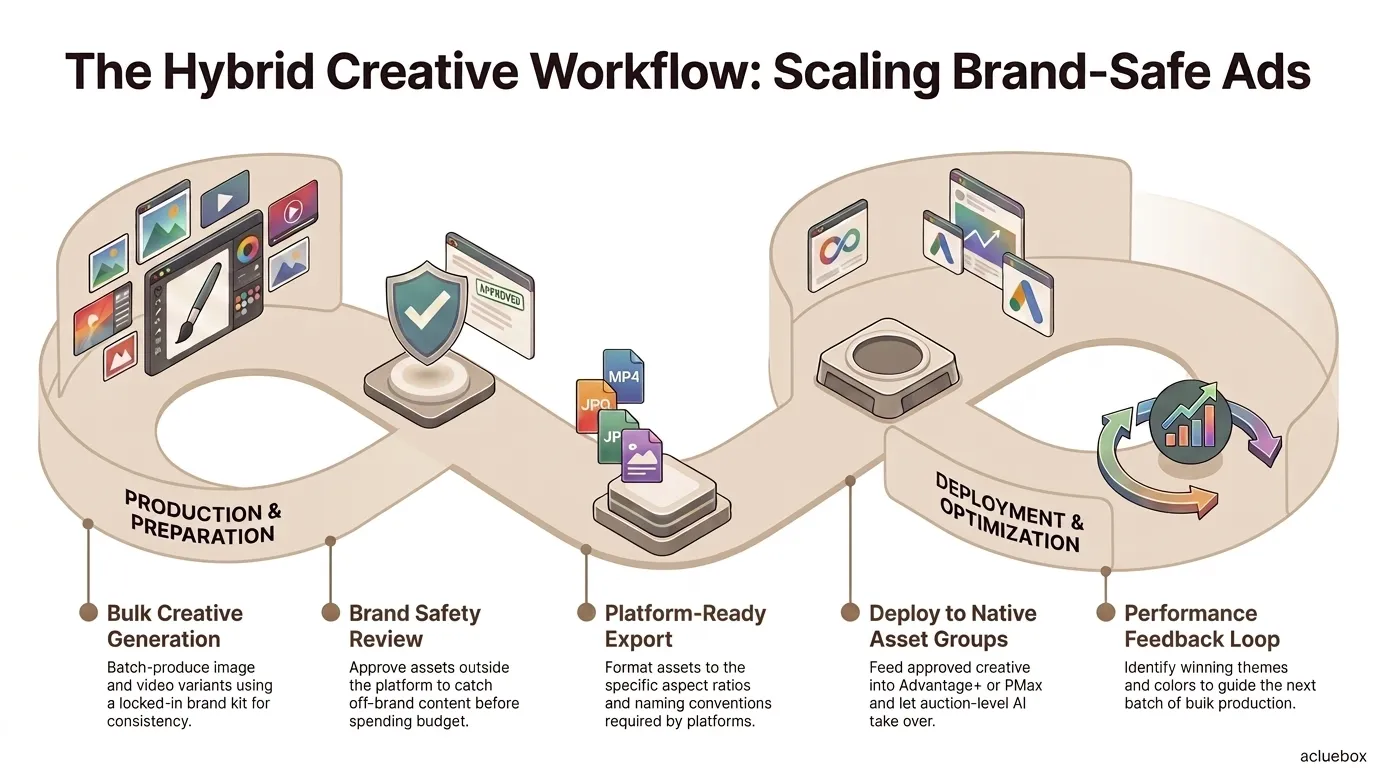
The workflow looks like this:
This sequencing means you never ask the native platform to do something it's not built for (careful, brand-consistent design) and you never ask the standalone tool to do something it can't do (real-time auction optimization). Each tool works in the phase where it's genuinely the stronger option.
Build a simple naming convention and folder structure for exported assets before you scale this workflow. When you're pushing dozens of SKU variants into asset groups weekly, disorganized exports become the actual bottleneck, not the generation itself.
Not every advertiser needs the full hybrid pipeline. The right setup depends heavily on catalog size, channel spread, and team capacity.
Single-SKU small businesses succeed best by relying directly on native tools. When promoting one product on few channels with modest spend, Advantage+ and PMax deliver faster results with zero setup overhead. You only need dedicated creative software when expanding across channels or requiring strict brand oversight.
High-volume, multi-SKU brands and agencies gain the most from hybrid workflows. Managing extensive product catalogs or multiple client accounts demands bulk creative generation and brand governance that native tools cannot provide. Dedicated software supplies consistent assets rapidly, while native platform AI optimizes live auction delivery.
Team size matters as much as catalog size here. A lean team managing a large catalog will feel the pain of manual creative production faster than a large team managing a small catalog, even if their ad spend looks similar.
A few patterns show up repeatedly when teams get this trade-off wrong.
The first is treating native platform outputs as final brand assets. Advantage+ and PMax generate for performance, not for archive quality. Pulling those auto-generated crops and overlays out for use in other marketing materials usually produces inconsistent, off-brand results.
The second is over-managing native campaigns by manually swapping creative too frequently. Both platforms need a learning period to test combinations properly. Constantly interrupting that cycle with new uploads resets the optimization and usually hurts performance rather than helping it.
The third is under-investing in the standalone tool's brand kit setup. The value of a dedicated generator collapses if every asset still needs manual correction before it's brand-safe. Spending the time upfront to lock in colors, fonts, logo placement, and tone pays off across every future batch.
Native platform AI and standalone creative generators aren't competing for the same job. One is built to win the auction in real time, adjusting delivery faster than any human team could manage. The other is built to protect your brand and give you a creative library that works everywhere, not just inside one platform's walls.
Understanding that distinction is what turns this from an either-or decision into a workflow question, and the hybrid approach, generate and govern outside the platform, then deploy and optimize inside it, is how the most efficient teams are scaling creative without sacrificing either performance or brand integrity.
Yes, and for small, single-product accounts this is often the simplest path. Both platforms can generate and test creative directly from a handful of uploaded assets, so you don't strictly need a separate tool to run a functional campaign.
Not automatically. You need to export in the aspect ratios, file types, and size limits each platform requires for its asset groups. Most dedicated generators support common ad platform specs, but it's worth checking format requirements before a bulk upload.
It can add time upfront, since you're generating and reviewing assets before they ever touch the ad platform. For simple, low-volume campaigns this extra step may not be worth it, but for multi-SKU or multi-platform accounts, it usually saves time overall by avoiding rework later.
It varies by platform and campaign type, but both Advantage+ and PMax make automated decisions about cropping, text placement, and asset combinations that you don't directly control. If brand consistency is a strict requirement, a pre-upload review step with brand-safe, pre-approved creative reduces this risk significantly.
No. Agencies feel the benefit fastest because of client volume, but any brand managing more than a small handful of SKUs or running on more than one ad platform will typically see the same production and consistency gains from combining the two approaches.