
The Hidden Pitfalls of AI Ads: Brand Hallucinations, Compliance Risks, and Budget Dilution
Why AI-generated ads mangle logos, trigger compliance flags, and quietly drain budget through over-generated variants.
Why AI-generated ads mangle logos, trigger compliance flags, and quietly drain budget through over-generated variants.
AI advertising promised speed, launching full campaigns in hours instead of weeks. However, image models predict pixel patterns rather than understanding brand rules, legal constraints, or ad budgets. That gap often leads to costly mistakes.
This guide explores three major pitfalls in production: distorted packaging, hidden compliance risks, and budget dilution from excessive variants. Recognizing these issues helps teams install practical guardrails before scaling their ad spend.
Diffusion models and other image synthesis systems are trained to produce plausible images, not accurate ones. That distinction matters enormously in advertising, where a single blurred word on a label or a slightly warped logo can turn a beautiful ad into a liability.
Image models learn general visual patterns across millions of pictures, not your specific brand assets. When prompted, the model generates plausible packaging shapes and fills in missing logos, fonts, or colors with statistical guesses that are often wrong.
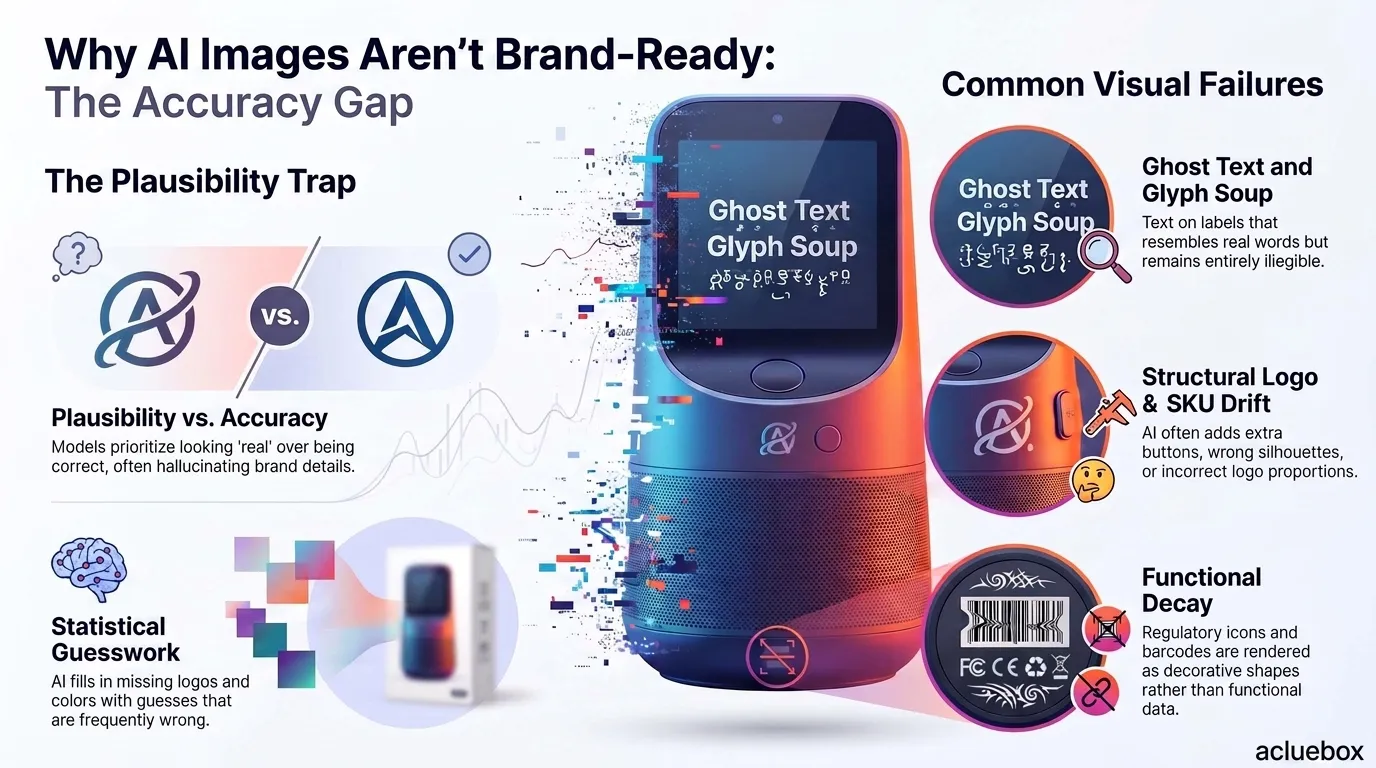
Common failure patterns include:
For everyday lifestyle and background imagery, this sloppiness is often invisible to the average viewer. But for hero shots where the product itself is the subject, or for any regulated category where label accuracy is a legal requirement, it's a serious problem.
The teams getting reliable results have mostly stopped asking image models to synthesize the product from scratch. Instead, they use a hybrid pipeline:
This approach keeps the creative flexibility of generative AI while treating the product itself as a fixed, trusted asset rather than something to be reinvented on every generation. It's more engineering work upfront, but it removes the single biggest source of embarrassing output.
Build a "golden asset" library, transparent PNGs or vector files of every approved product angle, logo lockup, and label variant. Feed generation pipelines instructions to composite from this library rather than synthesize packaging freehand. This one change eliminates most brand hallucination issues.
Logos and labels are the most obvious risk, but brand guardrails extend further: color palettes, typography, tone of voice in generated copy, and even the demographic makeup of AI-generated people in lifestyle shots. A useful mental model is to treat your brand guidelines as a machine-readable constraint set, not just a PDF that sits in a shared drive.
Practical guardrails worth setting up:
Brand guardrails work best as a checklist embedded in your workflow tool, not a document someone has to remember to consult. If the check isn't automatic or forced, it will eventually get skipped during a busy launch week.
Image problems are usually visible. Compliance problems are often invisible until someone outside the marketing team, a platform's ad review system, or a competitor's legal team, points them out. Large language models generating ad copy are optimized to sound persuasive and confident, which is exactly the tendency that gets advertisers into trouble.
AI copy generators frequently produce phrases like the best, guaranteed results, or clinically proven because models mimic persuasive marketing patterns. Models do not know whether your product has the evidence required to support those bold statements.
Regulatory agencies require proof for comparative claims and superlatives. Since AI tools cannot verify your legal documentation, they can easily invent scientific or performance claims that create serious regulatory exposure.
Some product categories carry additional legal weight, and generic AI models have no built-in awareness of category-specific advertising law. A few examples:
| Category | Common AI-Generated Risk | Why It Matters |
|---|---|---|
| Pharmaceuticals and supplements | Disease-treatment claims, missing required disclaimers | Health claims are heavily regulated; unsubstantiated claims can trigger warning letters |
| Financial services | Guaranteed return language, missing risk disclosures | Financial promotions law generally requires risk disclaimers on any performance claim |
| Alcohol | Imagery implying social or health benefits, appeal to minors | Many jurisdictions restrict imagery and audience targeting for alcohol ads |
| Children's products | Age-inappropriate persuasive tactics, unverified safety claims | Advertising to children carries stricter truthfulness and format standards |
| Weight loss and beauty | Before/after implications, guaranteed outcome language | High regulatory scrutiny due to history of deceptive marketing |
Maintain a category-specific "red flag" word and phrase list for each regulated product line you advertise, and run every AI-generated headline and body copy variant through that filter before it reaches a human reviewer. Treat the filter as a first pass, not a replacement for legal review.
The teams that avoid compliance incidents generally add a distinct review layer between generation and publication, separate from the brand guardrail check described above. This layer typically includes:
Platform ad review systems (Meta, Google, TikTok, and others) run their own automated compliance checks and will reject or restrict accounts for repeated violations. A strong internal review layer isn't just about avoiding regulators, it's about protecting your ad account's standing with the platforms themselves.
The most unexpected pitfall in AI ad generation isn't about quality at all. It's about statistics, and it tends to bite teams who did everything else right.
AI makes producing dozens of ad variants effortless, tempting marketers to launch everything at once. However, flooding ad sets with too many options divides ad spend and undermines the statistical significance needed to find true winners.
Every ad variant requires sufficient impressions and conversions to distinguish genuine performance from random chance. Testing more variants simultaneously raises that required threshold and increases false positive results.
Consider a simple scenario. A brand has a 10,000 dollar monthly budget for a campaign.
Testing 50 variants creates an illusion of thorough experimentation. In reality, delivery algorithms pick winners based on early random clicks rather than statistically sound conversion data.
Before launching any AI-generated variant set, calculate the minimum spend per variant needed to reach statistical significance for your category's typical conversion rate and cost per result. Divide your total test budget by that number to find your maximum sensible variant count, not the other way around.
A more disciplined approach treats AI's generation capacity as a sourcing tool, not a testing plan. The workflow looks like this:
This turns AI generation into what it's actually good at, cheap exploration of a wide creative space, while keeping the expensive part, live paid testing, disciplined enough to produce a trustworthy answer.
| Approach | Variants Launched | Spend Per Variant | Statistical Reliability | Typical Outcome |
|---|---|---|---|---|
| Spray and pray | 40 to 100 | Very low | Low, mostly noise | Flat or declining performance, unclear learnings |
| Shortlist and scale | 4 to 8 | Adequate for significance | High | Clear winner identified, budget reallocated with confidence |
| Single hero ad | 1 | All budget | Not applicable, no comparison | Fast to launch, but no learning and vulnerable to fatigue |
Ad fatigue is a separate problem from budget dilution, but the two interact. Even a well-tested winning variant needs periodic refreshes as audiences see it repeatedly and response rates decline. Keep a bench of pre-screened backup variants ready rather than generating new ones under time pressure once fatigue sets in.
Ad platforms require a minimum number of conversions per ad set to exit their learning phase and stabilize delivery. Launching too many variants at once fragments this signal, which delays optimization and hurts performance.
Keep active variant counts low enough so each creative can hit the conversion threshold within the first week. Use AI to build a staged queue of tested replacements rather than publishing dozens simultaneously.
These pitfalls are not reasons to avoid AI in advertising. Instead, establish clear guardrails before scaling. Composite real product assets into generated scenes, route copy through compliance filters, and run disciplined tests on a few variants at a time.
Winning brands do not simply produce the most creatives. They combine rapid generation with rigorous, automated quality control at scale.
Generally not reliably enough for production use in hero shots. Current image synthesis models approximate packaging based on patterns learned from training data rather than reproducing an exact reference. Compositing a verified product asset into an AI-generated scene remains the more dependable approach for anything where label accuracy matters.
The advertiser, not the AI vendor, typically bears responsibility for claims made in its advertising, regardless of what tool produced the copy. This is why a compliance review layer separate from creative review is essential before any AI-generated claim goes live.
It depends on category cost per result and available budget, but the guiding principle is to divide total test budget by the minimum spend needed per variant to reach statistical significance, then cap variant count at that number rather than choosing a variant count first.
It can, if the output includes prohibited claims, misleading imagery, or policy violations that a human reviewer would have caught. Platforms apply the same policies to AI-generated and traditionally produced creative, so the same review discipline should apply to both.
Start with a golden asset library for products and logos, a locked color and typography reference, and a banned-claims list for copy. These three components catch the majority of common issues and can typically be built and integrated into an existing pipeline within a few weeks.

