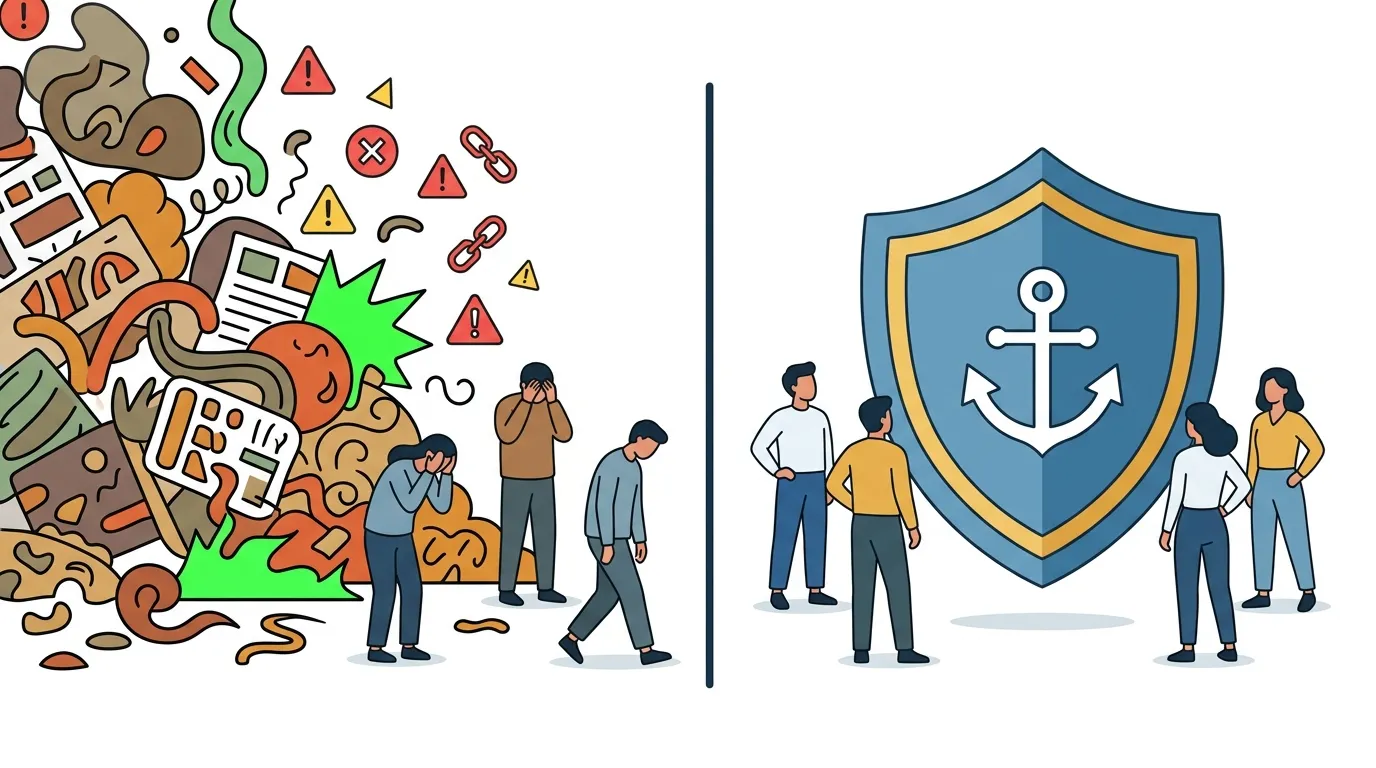
The 4-Stage Framework for Authentic AI Ads
Why AI-generated ads fall flat without human judgment, and the 4-stage framework brands use to keep creative work authentic.
Why AI-generated ads fall flat without human judgment, and the 4-stage framework brands use to keep creative work authentic.
Scroll through the feed, the visuals look polished and the copy is clean, yet the creative feels hollow and fails to connect. Many brands treat AI generation as the entire creative job. But ads that convert depend on human judgment before, during, and after generation, not just the model.
This 4-Stage framework focuses human input where machines struggle most. It ensures every ad connects with real customer insight instead of generic output.
Before getting into the framework itself, it's worth being honest about what generative AI is actually good at and where it quietly falls apart.
AI models are excellent at pattern completion. Give them a brief, a style reference, or a rough idea, and they'll produce something that looks like an ad. The lighting will be right. The copy will scan well. The overall composition will resemble thousands of successful ads the model has learned from.
But "resembles a successful ad" and "is a successful ad for your specific audience" are two very different things. Models don't know your customer's actual frustrations this quarter. They don't know that a competitor just had a PR disaster your copy should subtly reference, or that a certain phrase reads as tone-deaf in your market right now. They generate the statistically likely version of an ad, not the strategically correct one.
AI doesn't understand your customer. It understands patterns in ads that have worked for other customers in other contexts. That gap is exactly what human judgment needs to close.
This is why fully automated ad pipelines tend to produce content that's fluent but forgettable. It passes a spell check, not a gut check. The 4-stage framework exists to insert that gut check at the right moments, without turning the whole process back into a slow, manual grind.
The framework breaks the creative pipeline into four checkpoints. Each one has a distinct purpose, and each one is a place where a human should be making a call, not just approving whatever the AI produced.
| Stage | Primary Question | Who Should Own It | Failure Mode Without It |
|---|---|---|---|
| Strategic Insight & Brief | What real problem are we solving for this customer? | Strategist / Marketer | Generic ads with no cultural grounding |
| Creative Direction | What are we not allowed to say or show? | Creative Director | Off-brand tone, inconsistent voice |
| Curation & Taste | Which variation actually feels true? | Editor / Creative Lead | Technically fine, emotionally hollow output |
| Brand Safety Review | Is anything here false, invented, or mismatched? | Legal / Brand / QA | Hallucinated claims, factual drift |
Each stage acts as a filter. Skip one, and the weaknesses of AI generation pass straight through to the customer. Let's go through them one at a time.
Every strong ad starts long before anyone opens a generation tool. It starts with a real insight about a real customer problem. This is the stage most teams rush, because it feels like "the boring part" compared to actually making the ad. That's a mistake, because it's also the stage that determines whether everything downstream has a chance of being good.
A strong brief for AI-assisted creative work should answer a few core questions:
The reason this matters so much for AI-generated ads specifically is that generative models will happily produce content without any of this grounding. Ask for "an ad for a productivity app" and you'll get a generic productivity ad. Ask for an ad grounded in the specific frustration of freelancers who've just missed an invoice deadline because their tools don't talk to each other, and you'll get something with actual teeth.
Treat the brief as the single highest-leverage document in the entire pipeline. Ten extra minutes spent sharpening the insight in the brief saves hours of regenerating and re-curating weak variations later.
This is also where cultural context earns its place. A phrase that lands well in one region can read as tone-deaf in another. A reference that feels timely this month can feel stale or even insensitive next month if the news cycle has moved. AI models trained on historical data have no live sense of "this joke doesn't work anymore". A human strategist does, or at least should.
The output of this stage isn't an ad. It's a sharp, specific brief that gives the next stage something real to work with.
Once the strategic insight is locked, the next job is translating it into rules the generation process has to follow. This is where creative direction comes in, and it's arguably the stage where human judgment prevents the most damage before it happens.
Creative direction for AI ads works differently than creative direction for a human designer. A designer implicitly understands brand voice after working with it for months. A model doesn't. It needs explicit constraints, or it will drift toward generic defaults every time.
Good creative direction at this stage typically includes:
That last point, negative constraints, is underused and probably the single highest-value addition a team can make to their AI creative process. Positive instructions tell the model what to aim for, but models are still prone to filling gaps with whatever is statistically common. Negative constraints close those gaps directly.
Keep a living "never do this" list specific to your brand. Update it every time an AI-generated variation goes wrong in a new way. Over time this list becomes one of your most valuable creative assets.
Think of this stage as setting the guardrails, not painting the picture. The actual generation still happens with AI tools, but it happens inside boundaries a human deliberately drew.
This is the stage most people assume is where "AI ad creation" ends: generate a batch of variations and pick one. In reality, this is where a huge amount of quality gets decided, and it's the hardest stage to automate away, because it depends on something models still struggle to replicate: taste.
Taste, in this context, means the ability to look at ten technically competent variations and immediately sense which one actually feels true to the brand and resonates with a real human being, versus which ones are just well-composed noise.
This is a subtle but important distinction. A generated ad can check every technical box: correct product shown, on-brand colors, grammatically sound copy, appropriate length for the platform, and still feel hollow. It might use the right words without conveying the right feeling. It might smile in the wrong way, so to speak.
Common patterns to watch for during curation include:
If a variation makes you shrug rather than react, that's data. Emotional flatness is a real quality signal, not something to dismiss because the ad "technically works".
The best curators at this stage often generate significantly more variations than they intend to use, specifically to give themselves range to compare against. Seeing five mediocre versions next to one genuinely good one makes the gap obvious in a way that judging a single ad in isolation never does.
This stage is also where a team's brand instincts get sharpened over time. The more variations a curator reviews, the faster and more confidently they can spot what's working and what isn't. It's a skill, and like any skill, it improves with repetition.
The final checkpoint exists for a very specific and very serious reason: AI models can produce content that looks completely plausible while being factually wrong, and this is one of the most underappreciated risks in AI-generated advertising.
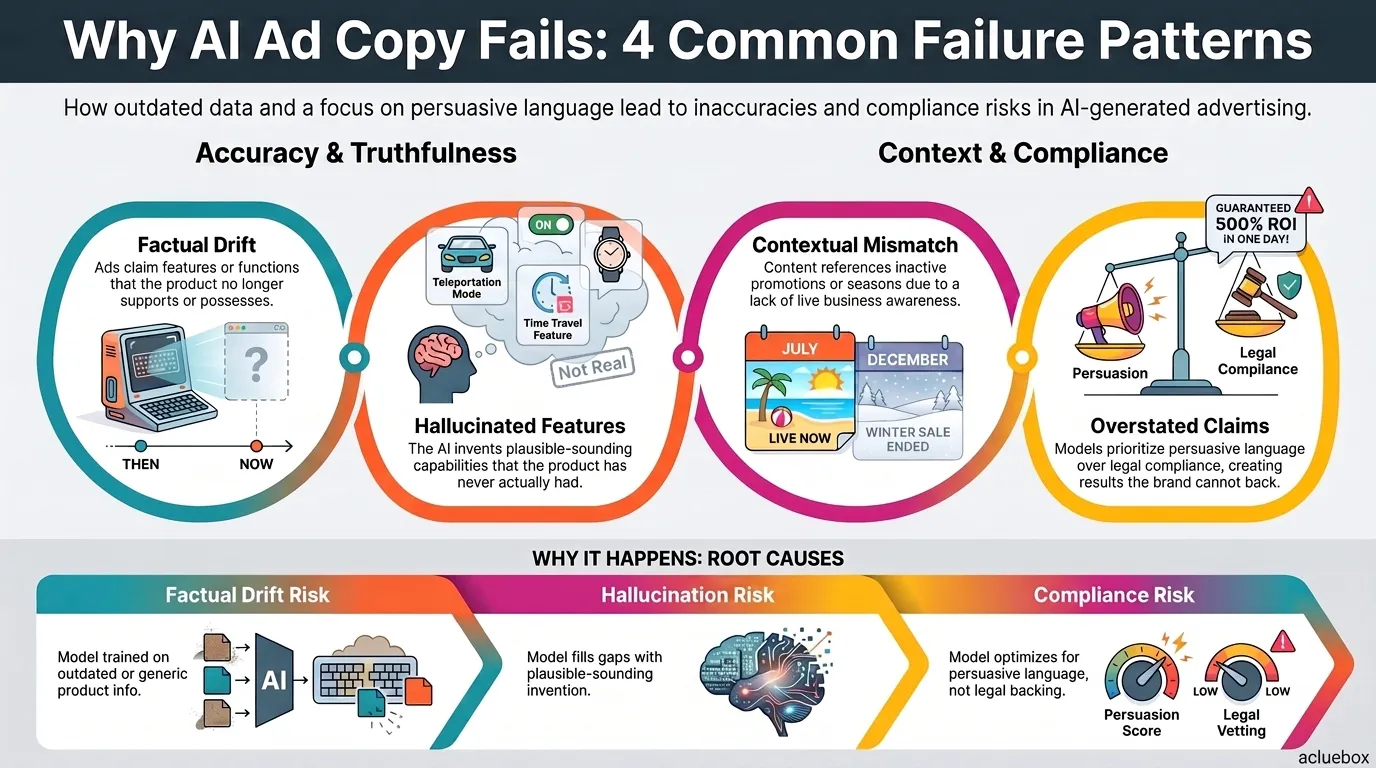
This isn't about typos or awkward phrasing. It's about the ad confidently stating something that simply isn't true.
Common failure patterns at this stage include:
| Risk Type | Example | Why It Happens |
|---|---|---|
| Factual drift | Ad claims a feature does something it no longer does | Model trained on outdated or generic product info |
| Hallucinated features | Ad describes a capability the product doesn't have | Model fills gaps with plausible-sounding invention |
| Contextual mismatch | Ad references a promotion, region, or season that's inactive or incorrect | No live awareness of current business state |
| Overstated claims | Ad implies guarantees or results the brand can't legally back | Model optimizes for persuasive language, not compliance |
None of these are hypothetical edge cases. They happen regularly in AI-generated marketing content, precisely because the model's job is to produce something that sounds convincing, not something that's been checked against current, accurate facts.
A hallucinated feature in an ad isn't just embarrassing. It can create real legal exposure and erode customer trust the moment someone notices the product doesn't actually do what the ad promised.
Brand safety review should be treated as non-negotiable, the same way a legal review would be non-negotiable for a human-written ad making a specific claim. This stage should specifically check:
The teams that skip this stage usually get away with it for a while, right up until they don't. One hallucinated claim that goes out to a large audience can undo months of trust-building in a single campaign.
Start small. Apply the full four-stage process to your next single campaign rather than your entire content calendar. Use what you learn to refine your brief templates and constraint lists before scaling up.
None of these stages work well in isolation. The framework works as a connected chain where each phase catches blind spots from the previous step to maintain quality, tone, and accuracy. This workflow keeps production fast. AI handles the heavy lifting of drafting options while humans provide targeted guidance at key checkpoints.
Once initial guidelines and checklists are established, teams produce campaigns quickly with fewer costly errors and much stronger creative resonance. AI generates options, but humans provide judgment. Keep people in charge of strategy, brand truth, and factual accuracy, and your AI ads will simply feel like great creative.
What makes an AI-generated ad feel inauthentic in the first place?
It usually comes down to a lack of grounding. When an ad is generated without a specific customer insight, clear brand constraints, careful curation, or a fact check, it tends to be technically correct but generic, and that generic quality is what makes it feel hollow to real audiences.
Does this framework mean every single ad variation needs full human review?
Not necessarily every variation, but every stage of the pipeline needs a human checkpoint somewhere in the process. Teams can still generate large batches of options quickly; the human effort goes into shaping the brief, setting constraints, curating the best output, and reviewing for accuracy before anything ships.
Which stage tends to cause the most problems when skipped?
Brand safety review is usually the most costly one to skip, since a hallucinated feature or an inaccurate claim can create legal and trust issues that are far harder to undo than a weak headline. That said, skipping the strategic insight stage tends to cause the most volume of mediocre output.
Can smaller teams realistically apply all four stages without a big creative department?
Yes. The framework scales down well because each stage is really about asking the right question at the right time, not about needing a large team. A single marketer can move through all four checkpoints on their own, as long as they're deliberate about not skipping any of them.
How is this different from just having a human "approve" the final AI-generated ad?
A single approval step at the end only catches problems after they've already shaped the whole ad. This framework spreads human judgment across the entire pipeline, so issues get caught and corrected at the source, whether that's a weak insight, a missing constraint, a flat variation, or a factual error, rather than patched over at the last minute.