Deconstructing AI Slop: Warning Signs, Consumer Fatigue, and Brand Trust
How to spot low-effort AI content, why audiences tune it out, and what it quietly costs your brand's trust and long-term equity.
How to spot low-effort AI content, why audiences tune it out, and what it quietly costs your brand's trust and long-term equity.
Eyes glide across feeds, catch a generic shape, and move on without clicking or remembering anything. Marketers call this empty output AI slop. It describes content generated quickly to fill schedules rather than earn attention. While technically correct, it lacks voice, purpose, and genuine human care.
As frictionless tools flood feeds with generic output, audiences instantly spot machine mediocrity. When they do, their indifference quickly turns into brand distrust. Here is what AI slop looks like, why people reject it, and what it costs your brand.
AI slop refers to content, text, images, video, or audio, that is generated using AI tools with minimal human oversight, editing, or strategic intent. It's published primarily to hit a quota: a certain number of blog posts per week, a certain cadence of social posts, a certain volume of product descriptions.
The defining trait isn't that AI was involved. AI-assisted content can be excellent when it's guided by a clear point of view and refined by a human editor. Slop happens when the AI output is treated as a finished product rather than a first draft.
The issue is not the tool. It's the absence of judgment applied after the tool does its job. A first draft becomes slop the moment it gets published without anyone asking whether it's actually good.
Slop tends to share a few structural qualities regardless of format. It's optimized for the appearance of completeness, a headline, a body, a call to action, a title tag, without much thought given to whether any of it should exist in the first place. It answers a keyword rather than a question. It fills space rather than earning it.
Audiences can't always articulate why something feels off, but they recognize the pattern instantly. Four traits show up again and again in content that reads as machine-made and forgettable.
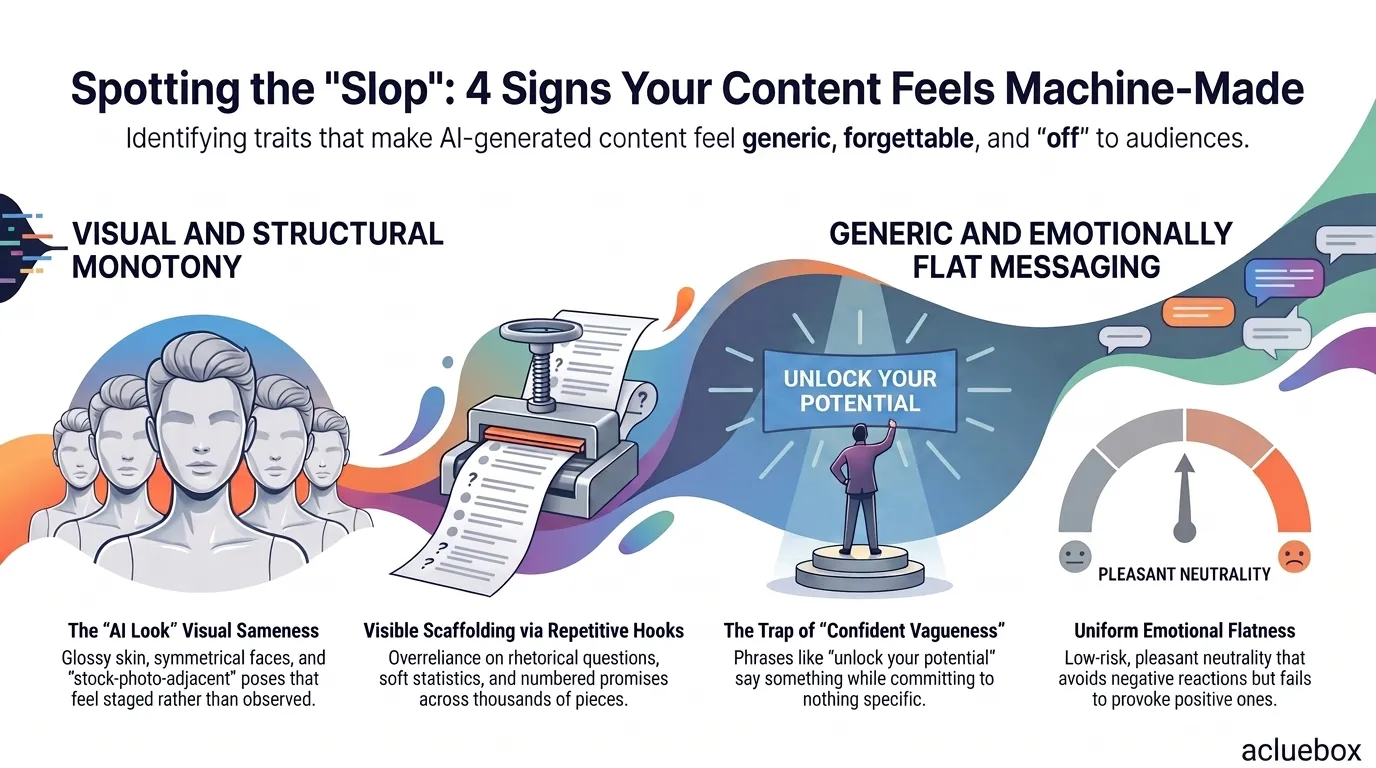
Generative image tools tend to converge on similar compositions, lighting, and color treatments unless someone actively pushes against the defaults. The result is a recognizable "AI look": slightly glossy skin, oddly symmetrical faces, a particular warm-cool color grade, and stock-photo-adjacent poses that feel staged rather than observed.
Scroll through enough LinkedIn carousels, blog headers, or email banners and a visual monotony sets in. Different brands, different industries, same aesthetic fingerprint. When visuals stop being distinct, they stop being memorable, and a brand's visual identity, something companies spend years and real budget building, gets diluted into the same generic wash as everyone else's.
Slop copy tends to speak in a register best described as confident vagueness. Phrases like "unlock your potential", "take your business to the next level", or "in today's fast-paced world" show up because they are statistically safe, not because anyone chose them deliberately. The copy technically says something while committing to nothing specific about the product, the audience, or the moment.
This kind of writing is often the output of prompting an AI model for "a compelling paragraph about X" without providing real customer insight, brand voice guidelines, or a specific claim to make. The model fills the gap with the most probable, least risky phrasing it can generate, which is precisely what makes it forgettable.
Good marketing content, even short-form and transactional content, carries some emotional register: humor, urgency, warmth, tension, relief. Slop tends to flatten all of that into a uniform, pleasant neutrality. Nothing is offensive, but nothing lands either.
This flatness often comes from AI models being tuned toward broadly agreeable, low-risk output, combined with the absence of a human editor pushing for a sharper angle. The result reads like it was written to avoid a negative reaction rather than to provoke a positive one, and audiences can feel that caution even if they can't name it.
Open a handful of AI-assisted blog posts or social captions and a pattern of openers emerges fast: rhetorical questions, "Here's the thing", numbered promises, or a soft statistic dropped in the first line without context. These hooks aren't wrong on their own, they're common because they work in isolation. But when the same three or four structures appear across thousands of pieces of content simultaneously, audiences start recognizing the scaffolding instead of engaging with the substance.
A quick diagnostic: if you removed your brand name and logo from a piece of content, could a reader tell it came from you specifically, as opposed to any competitor using the same generative workflow? If not, it's likely slop, regardless of how it was produced.
Ad blindness isn't new. Banner ads have been ignored for decades, and consumers have long since learned to scroll past anything that visually screams "advertisement". What's different now is the speed and scale at which a new form of blindness has developed, one aimed specifically at AI-generated sameness.
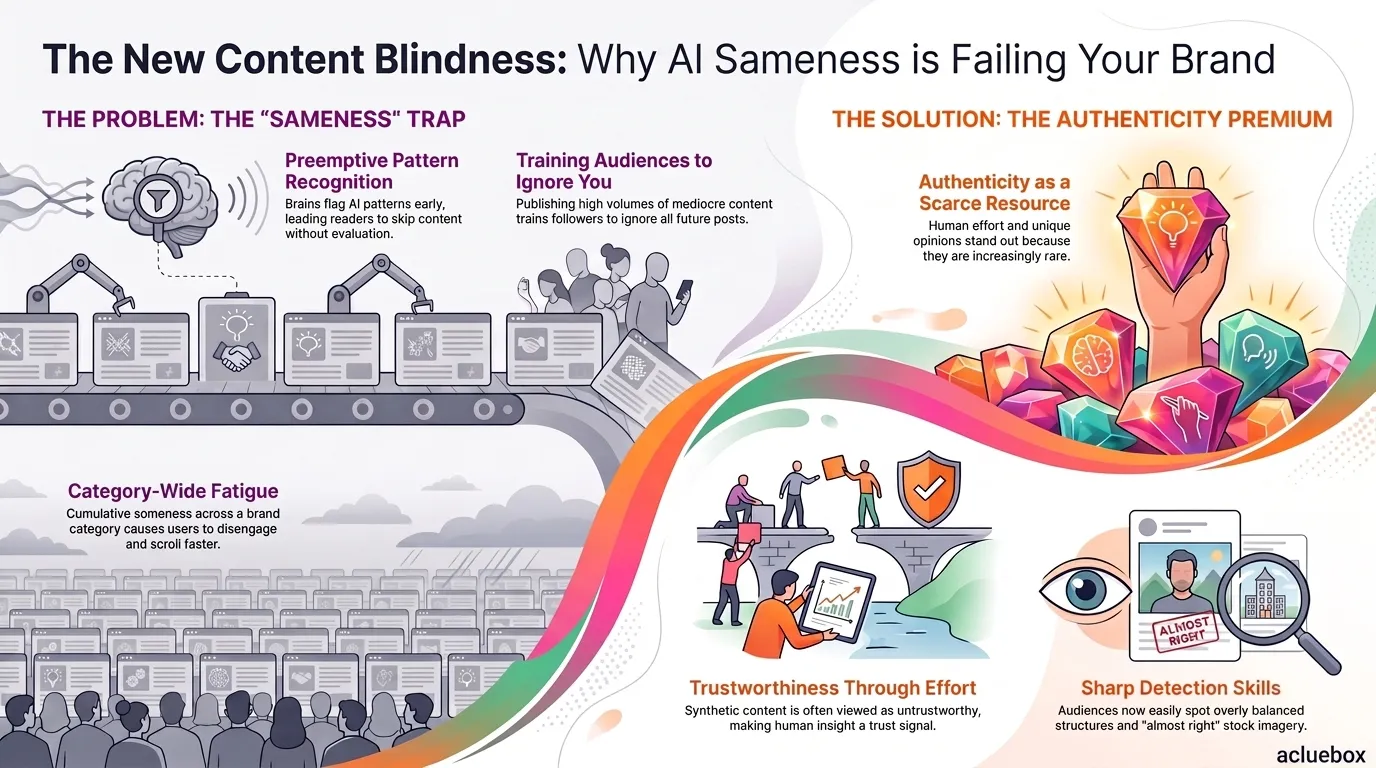
Pattern recognition happens fast, and it generalizes. Once a person's brain flags a certain visual or verbal pattern as "content I don't need to read", that filter applies broadly. A reader who has learned to skip past generic AI-written LinkedIn posts doesn't evaluate each new post on its merits; they apply the filter preemptively. This means brands publishing high volumes of average content aren't just failing to gain attention with the mediocre pieces, they're training audiences to ignore future content from them too, including work that might have genuinely been worth reading.
Volume without differentiation breeds fatigue. When every brand in a category adopts a similar AI-assisted production workflow around the same time, the entire category starts to look and sound the same. Fatigue sets in not because any single piece of content was bad, but because the cumulative sameness becomes exhausting to sift through. Consumers respond by disengaging from the format altogether, unfollowing, unsubscribing, or simply scrolling faster.
Authenticity has become a scarce resource, and audiences price it accordingly. In a media environment saturated with synthetic content, evidence of real human effort, a specific opinion, an unusual observation, a genuinely useful piece of information, stands out precisely because it's rare. Audiences increasingly treat authenticity as a signal of trustworthiness, which means content lacking it doesn't just get ignored, it can actively read as untrustworthy.
Detection is getting easier, not harder. Despite improvements in generative tools, audiences have become more attuned to telltale signs: the overly balanced sentence structures, the hedge-everything tone, the stock imagery that's almost but not quite right. Ironically, as AI content has become more common, the collective ability to spot it has also sharpened, because people have had more exposure and more practice.
| Signal | What Audiences Notice | What It Signals to Them |
|---|---|---|
| Visual sameness | Repeated poses, lighting, and color grading across unrelated brands | Low investment, no distinct identity |
| Generic messaging | Vague claims with no specific proof or detail | The brand doesn't understand its own product or customer |
| Emotional flatness | Content that provokes no reaction, positive or negative | The brand doesn't have a real point of view |
| Repetitive hooks | Familiar opening structures across many unrelated posts | Content was templated, not crafted |
| Publishing volume | A sudden spike in output with no corresponding rise in quality | Quantity is being prioritized over the audience's time |
The immediate cost of AI slop is obvious: low engagement, poor click-through rates, weak conversion. But the deeper costs compound over time and are harder to reverse.
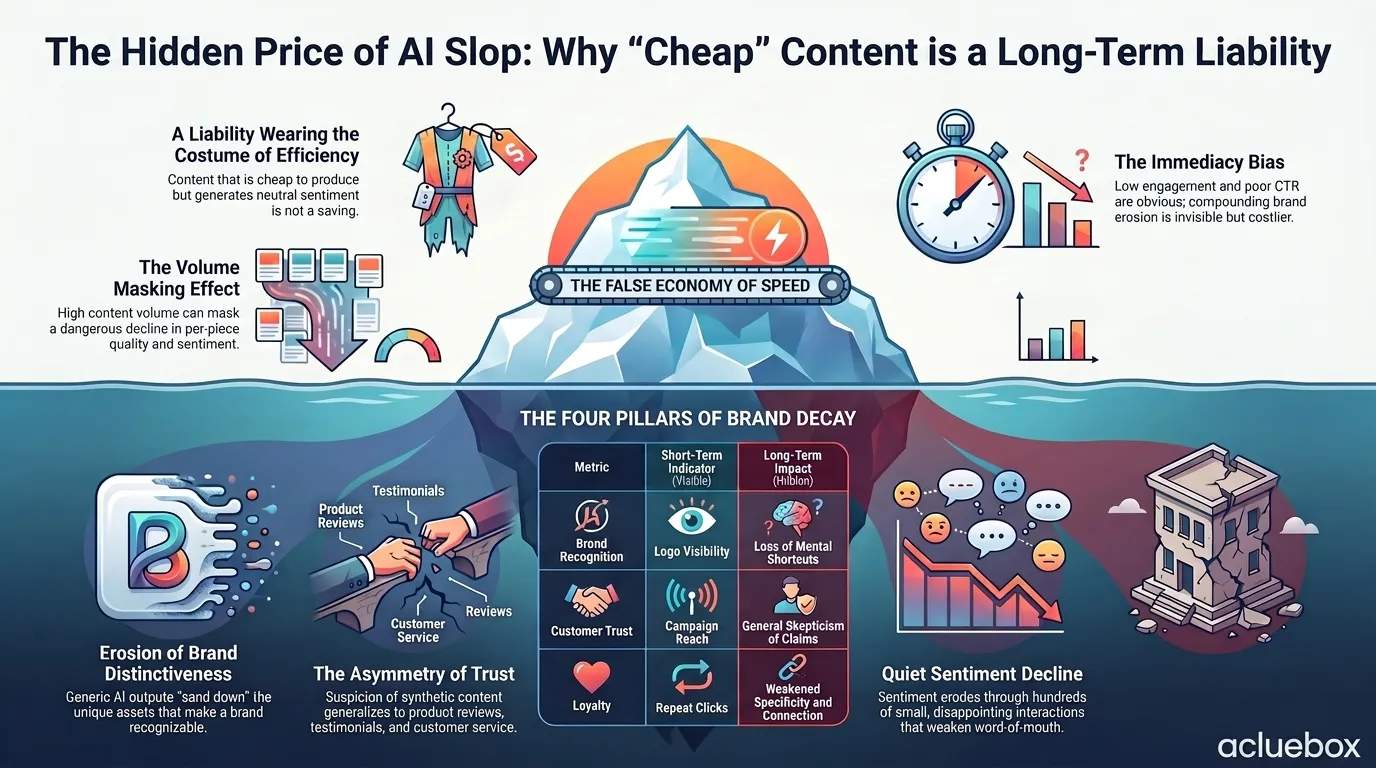
Brand equity is built substantially on distinctiveness, the set of visual and verbal assets that let a customer recognize a brand without seeing the logo. When content production leans heavily on default AI outputs, brands quietly sand down the very things that made them recognizable. Over months, a brand's feed can start to look interchangeable with a dozen competitors, which weakens the mental shortcuts customers use to choose one brand over another at the point of purchase.
Sentiment doesn't usually collapse from one bad campaign. It erodes gradually, through hundreds of small interactions that each register as slightly disappointing. A customer who repeatedly encounters generic, emotionally flat content from a brand doesn't necessarily complain about it. They simply start to feel less enthusiastic about that brand relative to others, a shift that shows up later in survey data, in reduced organic sharing, and in weaker word-of-mouth, long after any single piece of content is forgotten.
Track qualitative sentiment alongside engagement metrics. A brand can maintain stable click-through rates while sentiment quietly softens underneath, especially if content volume is masking a decline in per-piece quality.
Trust is asymmetric: it accumulates slowly and can be lost quickly. When audiences start to suspect that a brand's content is mass-produced without real oversight, that suspicion tends to generalize to the brand's other claims. If the blog posts feel synthetic, why would the product reviews, the customer testimonials, or even the customer service responses feel any different? Once a customer starts questioning the authenticity of one brand touchpoint, skepticism tends to spread to the rest of the relationship.
This is particularly costly in categories where trust is the primary purchase driver, healthcare, financial services, education, or anything involving a significant spend. In these categories, a single slop-flavored piece of content can do disproportionate damage relative to its production cost.
Loyal customers are typically won and kept through a sense that a brand understands them specifically. Generic, mass-produced content undermines exactly that sense of specificity. Over a long enough timeline, customers who feel unseen by a brand's communications become easier for competitors to win over, not because the competitor's product is necessarily better, but because the competitor's content made them feel more understood.
The cost of AI slop rarely shows up as a single line item. It shows up as a slow leak across brand recall, engagement rate, review sentiment, and repeat purchase rate, each individually small, collectively significant.
The appeal of AI-generated content at scale is obvious: lower cost per piece, faster turnaround, the ability to fill a content calendar without hiring additional staff. But this economy is false if the output degrades brand equity faster than it builds it. A piece of content that costs a fraction of a professionally crafted one but generates negative or neutral sentiment isn't actually cheap. It's a liability wearing the costume of efficiency.
None of this is an argument against using AI in content production. It's an argument against skipping the judgment that makes content worth publishing in the first place. Use this checklist to maintain high quality across every piece:
A useful internal rule: if a piece of content could have been written about three different competitors with only the logo swapped, it isn't ready to publish yet.
AI slop is not a technology issue but a quality control breakdown. Faster tools make it tempting to skip careful editing, brand alignment, and the discipline to cut weak work. Audiences quickly spot and reject generic synthetic material. Winning brands use AI output as a starting draft refined by human judgment, distinct voice, and real specificity.
What is the simplest way to tell if content is "AI slop"?
Ask whether the piece could be swapped for a competitor's logo without anyone noticing. If the messaging, visuals, and tone aren't specific enough to be recognizably yours, it's likely slop regardless of how it was produced.
Does using AI tools automatically mean the content will be slop?
No. AI-assisted content can be strong when a human editor applies real judgment, brand-specific detail, and a willingness to reject weak drafts. Slop happens when AI output is published without that layer of oversight.
How quickly do audiences start recognizing AI-generated patterns?
Fairly quickly, and the recognition tends to generalize. Once someone learns to filter out a certain visual or verbal pattern, they often apply that filter to future content from the same source without evaluating each piece individually.
What's the biggest hidden cost of publishing low-effort AI content?
The gradual erosion of trust and brand distinctiveness. These costs rarely show up as a single dramatic drop; instead they appear as a slow decline across recall, sentiment, and repeat engagement that's harder to trace back to its cause.
How can a brand increase content output without sinking into slop?
By setting publishing cadence based on how much genuinely good content the team can produce, rather than an arbitrary calendar target, and by keeping human editorial review as a real filter rather than a formality.