
Strategic Content Pillar & Theme Formulation: A Framework Before You Prompt
Establish 3-5 content pillars and quarterly themes so AI prompts produce connected, on-strategy posts instead of random ideas.
Establish 3-5 content pillars and quarterly themes so AI prompts produce connected, on-strategy posts instead of random ideas.
Why scattered content ideas keep happening?
Open a content calendar built entirely from "give me 10 blog post ideas" prompts and you'll usually see the same pattern: a productivity tip next to a product update next to a listicle about industry trends, with no thread connecting any of them. The posts might individually be fine, but together they read like the work of three different companies.
That's the cost of skipping strategy before prompting. AI tools are extraordinarily good at generating ideas, but they're only as focused as the input they're given, and a generic idea request has nothing to anchor itself to.
This is where content pillars and quarterly themes come in. Instead of asking an AI model to invent ideas out of thin air, you give it a structure to work within: a small number of foundational topics your brand owns, and a rotating set of angles that keep those topics fresh quarter over quarter. The result is a calendar that feels intentional, because it is.
A content pillar is a broad topic area that your business has the authority and audience interest to own. Most brands do well with somewhere between three and five pillars. Fewer than three and your content starts to feel one-note; more than five and you dilute focus to the point where pillars stop functioning as a filter.
Good pillars sit at the intersection of three things:
A SaaS company selling project management software might land on pillars like team collaboration, productivity systems, remote work culture, and project planning methodology.
A digital marketing agency might choose search engine optimization, conversion copywriting, lifecycle email automation, and performance analytics.
Notice that these aren't blog post titles. They're categories broad enough to generate dozens of posts over time, but specific enough that a reader immediately understands what the brand is about.
Pillars are not the same as blog categories on your CMS, though they often overlap. A pillar is a strategic commitment; a category is just a filing system. You can have pillars that never appear as a literal tag on your site.
If pillars answer what do we talk about, then quarterly themes answer what's the specific angle right now.
A pillar like productivity system is evergreen, but a quarterly theme narrows it to something timely: Q1: building systems for a fresh start, Q2: productivity for hybrid teams, Q3: automating the repetitive stuff before year-end crunch, Q4: closing out projects and planning next year.
This second layer matters because it prevents pillars from becoming stale repetition. Without it, you risk publishing five different "tips for better productivity" posts across a year that all say roughly the same thing. With a theme layer, each quarter's content under a pillar has a distinct reason to exist, tied to seasonality, business cycles, or campaign priorities.
Themes also give you a natural way to tie content marketing to broader business rhythms. If your company runs on quarterly OKRs, your content themes can mirror them directly, meaning your blog isn't just supporting the business abstractly, it's actively reinforcing the specific goals leadership is tracking that quarter.
It helps to see how these three layers relate before you start prompting an AI to fill them in.
| Layer | Scope | Lifespan | Example |
|---|---|---|---|
| Content Pillar | Broad topic area the brand owns | Ongoing, rarely changes | Remote work culture |
| Quarterly Theme | A specific angle on a pillar tied to timing or goals | 3 months | Rebuilding team rituals for hybrid teams |
| Post Idea | A single, publishable piece of content | One-time | "5 async rituals that replaced our daily standup" |
| Layer | Scope | Lifespan | Example |
|---|---|---|---|
| Content Pillar | Broad topic area the brand owns | Ongoing, rarely changes | Runway and cash flow management |
| Quarterly Theme | A specific angle on a pillar tied to timing or goals | 3 months | Extending burn rate ahead of annual budget resets |
| Post Idea | A single, publishable piece of content | One-time | "How we cut SaaS subscription bloat by 18% in 30 days" |
Each layer narrows the one above it. This is exactly the structure you want to feed into an AI prompt, because it mirrors how the model should reason: start broad, apply a lens, then get specific. Skip the first two rows and jump straight to asking for post ideas, and you're asking the model to invent structure and specifics simultaneously, which is where the disconnected, generic output comes from.
The reason this exercise works better with AI assistance than most generic brainstorming is that you already have raw material sitting in documents you've probably written for other purposes. Three sources are especially useful:
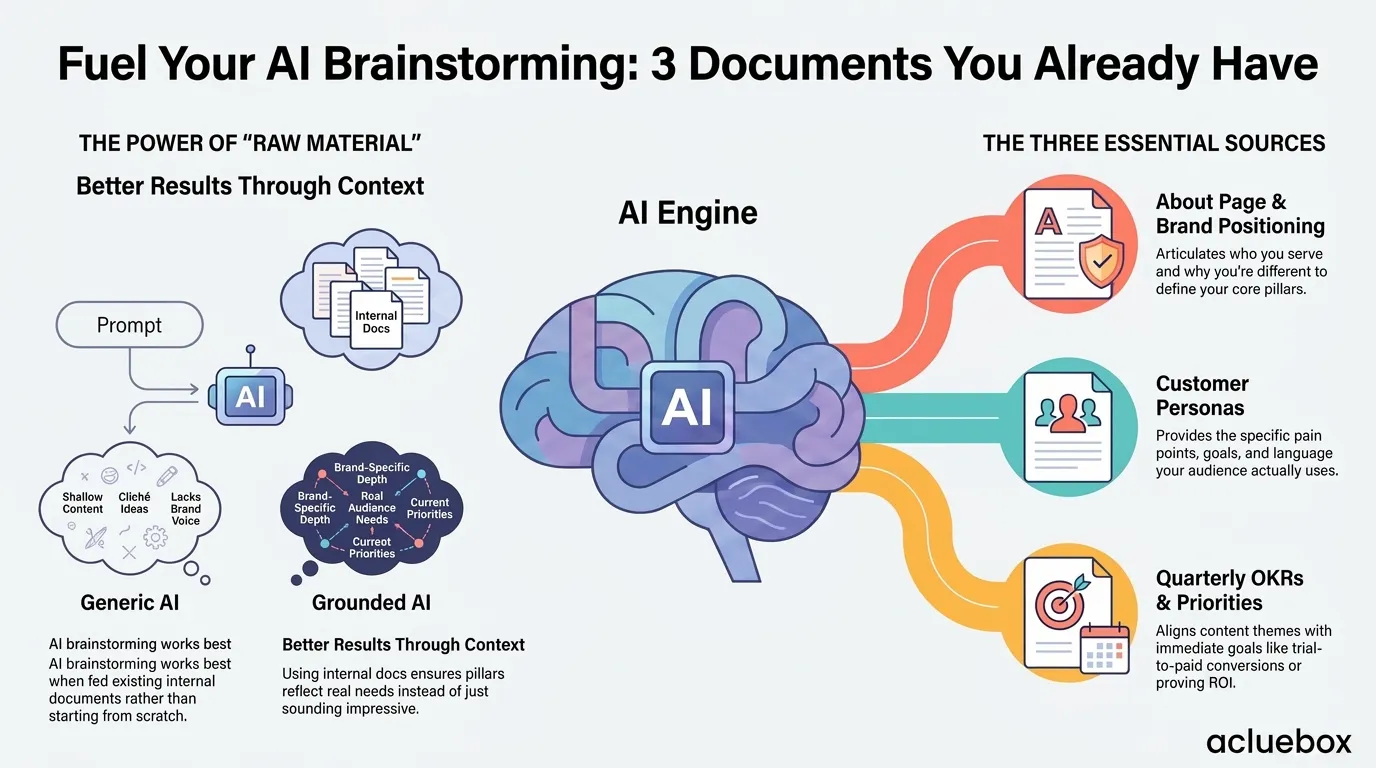
Your About page or brand positioning doc. This usually already articulates who you serve and why you're different, which is exactly the language you want pillars to reflect. If your About page says you help "operations leaders reduce manual busywork", that phrase alone hints at a pillar around workflow automation.
Customer personas. If you have documented personas, they typically include pain points, goals, and the language your audience uses to describe their problems. Feeding these into a prompt grounds your pillars in real audience needs rather than what sounds impressive internally.
Quarterly OKRs or campaign priorities. This is your best source for themes specifically. If this quarter's OKR is "increase trial-to-paid conversion by 15%", a theme built around onboarding friction or proving ROI early will directly support that goal, rather than existing in a content vacuum.
If you don't have formal personas or OKRs written down, don't let that block you. A few sentences describing your ideal customer and what the business is prioritizing this quarter is enough raw material to work with. The prompt below is built to work with informal inputs too.
The goal of this prompt is to get the AI to synthesize your existing brand materials into a small, defensible set of pillars, then propose theme angles for the upcoming quarter, all before a single post title gets generated. Treat this as a planning conversation, not a content-generation request.
You are helping me build a content strategy foundation before we generate any individual post ideas.

Here is context about my business:
About page / positioning: {{about_page_text}}
Target audience persona(s): {{persona_summary}}
Current quarterly goals (OKRs or priorities): {{quarterly_okrs}}
Existing content examples (optional, for tone reference): {{sample_content_links_or_titles}}

Your task has two parts:

Part 1: Propose {{number_of_pillars}} content pillars for my business. Each pillar should:
- Be broad enough to sustain many posts over a year, but specific enough to signal clear ownership of the topic
- Connect directly to something in my positioning or persona pain points
- Include a one-sentence rationale for why this pillar earns a place (audience fit, business fit, or both)

Part 2: For {{target_quarter}}, propose a theme for each pillar that:
- Narrows the pillar to a timely or goal-relevant angle
- References how it supports the stated quarterly goals where relevant
- Is specific enough that I could hand it to a writer without further clarification

Do not generate individual blog post titles yet. Stop at the theme level and wait for my confirmation before going further.
Here's what that looks like filled in for a fictional project management software company:
You are helping me build a content strategy foundation before we generate any individual post ideas.

Here is context about my business:
About page / positioning: We help distributed operations teams cut down on manual status updates and scattered spreadsheets by centralizing project tracking in one collaborative workspace, built for teams of 10-200 people.
Target audience persona(s): Operations managers and team leads at mid-sized companies, mostly remote or hybrid, who are currently using a mix of spreadsheets, Slack, and email to track projects and are frustrated by lack of visibility into where work actually stands.
Current quarterly goals (OKRs or priorities): Increase trial-to-paid conversion by 15%, reduce time-to-first-value for new signups, grow organic search traffic to the blog by 20%.
Existing content examples (optional, for tone reference): "Why your team's status meetings aren't working", "The hidden cost of spreadsheet project tracking"

Your task has two parts:

Part 1: Propose 4 content pillars for my business. Each pillar should:
- Be broad enough to sustain many posts over a year, but specific enough to signal clear ownership of the topic
- Connect directly to something in my positioning or persona pain points
- Include a one-sentence rationale for why this pillar earns a place (audience fit, business fit, or both)

Part 2: For Q4 2026, propose a theme for each pillar that:
- Narrows the pillar to a timely or goal-relevant angle
- References how it supports the stated quarterly goals where relevant
- Is specific enough that I could hand it to a writer without further clarification

Do not generate individual blog post titles yet. Stop at the theme level and wait for my confirmation before going further.
Notice the last line of the prompt template: it deliberately stops the AI before it jumps to post titles. This is the single most important instruction in the whole prompt. Without it, most models will happily skip straight to a list of 20 blog ideas, which defeats the purpose of building the foundation first.
Once the AI proposes pillars and themes, treat the output as a draft, not a final answer. A few checks worth running before you lock anything in:
Does each pillar pass the "could a competitor claim this too" test? If a pillar is so generic that any company in your space could use it word for word, it's not doing its job as a differentiator. Push the AI to sharpen it with a follow-up prompt referencing your specific positioning again.
Do the themes actually connect to the stated goals, or just gesture at them? It's easy for an AI to bolt on a sentence like "this supports conversion goals" without the theme genuinely doing that work. Ask yourself if a reader engaging with that theme's content would plausibly move closer to the OKR in question.
Is there real separation between pillars? Sometimes two proposed pillars are really the same idea phrased differently. If two pillars would produce overlapping post ideas, consider merging them or asking the AI to differentiate them further.
It's normal to go through two or three rounds of refinement here. This planning conversation is meant to be iterative, and the time spent gets paid back many times over once you start generating individual post ideas from a solid foundation.
Once your pillars and quarterly themes are set, generating individual post ideas becomes dramatically easier and more consistent, because now you're prompting within constraints instead of from a blank page.
A follow-up prompt might say something like "generate 6 blog post titles under the theme {{quarterly_theme}}, each targeting a different stage of the buyer's journey". The AI has structure to reason within, and you get ideas that visibly belong to the same content strategy rather than a grab bag of unrelated posts.
This shifts strategic thinking upstream. Rather than asking AI to invent both strategy and execution at once, you provide the direction and let AI handle what it does best: generating high volume variations inside clear boundaries.
Pillars and themes require regular updates rather than a single setup. Review pillars annually or after major positioning shifts, like pivots or new target markets. Refresh themes quarterly alongside your strategic goals so your pipeline mirrors current business priorities.
Maintain a central tracker in a spreadsheet or workspace tool listing active pillars, quarterly themes, and published links. This provides an easy audit trail, ensuring your publishing schedule stays balanced across core topics without unintentional bias.
Three is usually the right starting point for a small team, since it's enough to show topical range without spreading content production too thin. You can expand to four or five once you have consistent publishing capacity and see clear audience interest supporting a broader spread.
Not necessarily. Pillars are a strategic planning tool, while website categories are a navigation and SEO structure for readers. They often overlap, but you can maintain pillars internally even if your site's public-facing taxonomy is organized differently.
You can still use this framework with informal inputs. A short paragraph describing your typical customer and a sentence or two about what matters most to the business this quarter is enough to ground the AI's pillar and theme suggestions in something real rather than generic assumptions.
Even with stable goals, refreshing the angle each quarter keeps content from repeating itself. You can keep the same pillar and even a similar underlying goal, but shift the theme's seasonal hook, format, or specific pain point so the content doesn't feel like a rerun of last quarter's posts.
Yes, pillars and themes are channel-agnostic by design. Once you've established them for your blog, the same structure can guide social captions, newsletter topics, and even webinar planning, which also helps keep messaging consistent across every channel your audience encounters.

Stop Claude From Guessing: Prompting Tips for Accurate Answers

The 6-Element Voice Profile: Why AI Can't Protect a Voice You Never Documented

The Pre-Truncation Hook Formula: Prompting AI for the First 150 Characters

Generating Usable, Vector-Ready Logo Marks with AI

Anatomy of an AI-Ready Creative Brief: Components & Constraints